Understanding put options requires more than learning payoff diagrams. For institutional investors, the relevant question is how option contracts can alter the distribution of portfolio outcomes while preserving exposure to fundamentally attractive assets. Put options can establish explicit downside floors, monetize elevated implied volatility when written against appropriate capital commitments, or form part of broader synthetic overlays. These applications are particularly relevant to pension-style portfolios whose liabilities extend for decades and whose investment processes emphasize liquidity, balance-sheet resilience, cash-flow durability and total return rather than short-term price forecasts.
Canadian pension organizations such as CPP Investments and Ontario Teachers’ Pension Plan operate with long investment horizons and diversified allocations that include public equities, infrastructure, real estate, credit and private assets. Their precise derivative mandates differ and should be evaluated from their own disclosures rather than inferred from generic option strategies. Nevertheless, the institutional framework provides a useful model for understanding put options: derivatives are generally tools for modifying an existing economic exposure, managing liquidity or controlling portfolio risk rather than substitutes for fundamental security analysis.
Understanding Put Options From a Corporate Finance Perspective
Put options give their holder the right, but not the obligation, to sell an underlying asset at a specified strike price before or at expiration, depending on contract design. The buyer pays a premium for this right. The writer receives that premium and assumes the contractual obligation to buy the underlying security if exercise or assignment occurs. A general introduction to put option mechanics provides useful background, while the broader framework for an option contract helps distinguish contingent claims from ownership of the underlying business.
Understanding put options therefore begins with asymmetry. A long put has limited premium risk and potentially substantial value as the stock falls. A short put has limited maximum premium income but substantial downside exposure if the underlying company deteriorates. That asymmetry means valuation cannot be separated from corporate fundamentals. An investor willing to write a put on a regulated utility at $50 should be able to explain why purchasing the equity at an effective price below $50 remains attractive after considering leverage, capital expenditures, refinancing requirements, regulation and normalized free cash flow.
This distinction also separates conventional put options from instruments such as binary options, whose payoff structure is fundamentally different. Institutional portfolio construction focuses on the economic exposures created by a derivative, not simply whether two instruments share the word “option.”
The Economics of Long and Written Puts
Suppose a high-quality company trades at $100. A portfolio buys a $90 put for $3. At expiration, if the stock remains above $90, the put can expire worthless and the $3 premium represents the cost of protection. If the shares fall to $70, the put’s intrinsic value is approximately $20, materially offsetting the equity decline. Understanding put options in this context is analogous to evaluating insurance: the premium reduces expected return if the insured event never occurs, but it can preserve capital during severe adverse outcomes.
Now reverse the transaction. An investor writes the $90 put for $3 while maintaining enough liquidity to satisfy assignment. Ignoring transaction costs and taxes, the effective acquisition level is approximately $87 if assigned: the $90 strike less the $3 premium. If the investor’s conservatively calculated intrinsic value is $110, this structure may create an attractive entry point. But the premium does not eliminate fundamental risk. If impaired competitive economics reduce intrinsic value to $60, an $87 effective purchase price is still expensive.
This is why understanding put options requires a margin-of-safety framework. Strike selection should follow valuation; valuation should not be reverse-engineered to justify an attractive option premium. For related foundational concepts, Samxon.ca’s discussion of options investing places derivatives within a broader investment framework.
Free Cash Flow Comes Before the Option Premium
For an institution underwriting an equity position, net income is only one analytical input. Free cash flow is often more informative because shareholders ultimately depend on cash remaining after the expenditures required to maintain and expand the productive asset base. A simplified formulation is operating cash flow less capital expenditures, although analysts may make additional adjustments for acquisitions, working capital, leases and growth investment.
This distinction is especially important in infrastructure, telecommunications and utility businesses. These industries can generate predictable revenue while simultaneously requiring very large capital programs. Depreciation affects accounting earnings, but actual replacement of transmission assets, pipelines, networks or generating capacity consumes cash. Consequently, a dividend that appears sustainable at a 70% net-income payout ratio could be significantly less secure if dividends consistently exceed post-CapEx free cash flow.
A robust payout review therefore examines several variables together: dividend payments relative to normalized FCF, maintenance versus growth CapEx, net debt, interest coverage, debt maturities, regulatory recovery mechanisms and management’s capital-allocation priorities. Pension-style investors with multi-decade horizons care about these variables because contractual liabilities cannot be funded indefinitely from accounting earnings that fail to convert into cash.
Understanding put options reinforces this discipline. A premium received for writing a put cannot repair an overleveraged balance sheet. Likewise, put protection can mitigate market-price losses for a period but cannot restore the economics of a permanently impaired enterprise. Derivatives change portfolio payoff characteristics; they do not change the underlying company’s return on invested capital, debt obligations or capacity to produce FCF.
Implied Volatility and the Price of Protection
Implied volatility, or IV, represents the level of volatility embedded in option prices. Other factors being equal, higher IV increases option premiums because larger expected price movements make contingent option payoffs more valuable. Understanding put options during stressed markets therefore requires recognizing that protection often becomes most expensive when investors most urgently want it.
For a long-term institution, this creates competing choices. Purchasing puts during periods of low or moderate IV can establish predefined downside protection, but repeated hedging creates an ongoing premium drag. Selling puts when IV is elevated can capture a larger volatility premium, but doing so increases economic exposure precisely when uncertainty and correlations may be rising. Such writing is defensible only where liquidity reserves, position limits and fundamental underwriting support the obligation to acquire more of the asset.
It is consequently too simplistic to say institutions merely “sell volatility during stress to protect against downside.” Selling volatility does not inherently provide downside protection. Cash-secured put writing may reduce the effective acquisition price through premium received, while covered-call premiums may provide a modest buffer on an existing position, but both remain exposed to major equity declines. Genuine convex downside protection generally requires buying puts or constructing spreads that include long-option exposure.
Covered Calls as a Long-Term Overlay
A covered call combines ownership of an equity position with writing a call against that holding. Investors who need the call side of the option framework can review Understanding Call Options and the more specific discussion of writing covered calls on existing stock positions. In an institutional framework, however, covered calls are better viewed as an overlay modifying a core holding’s total-return distribution rather than a stand-alone pursuit of option income.
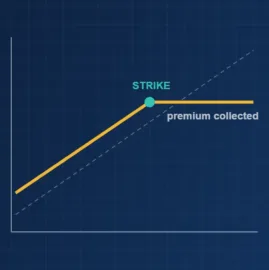
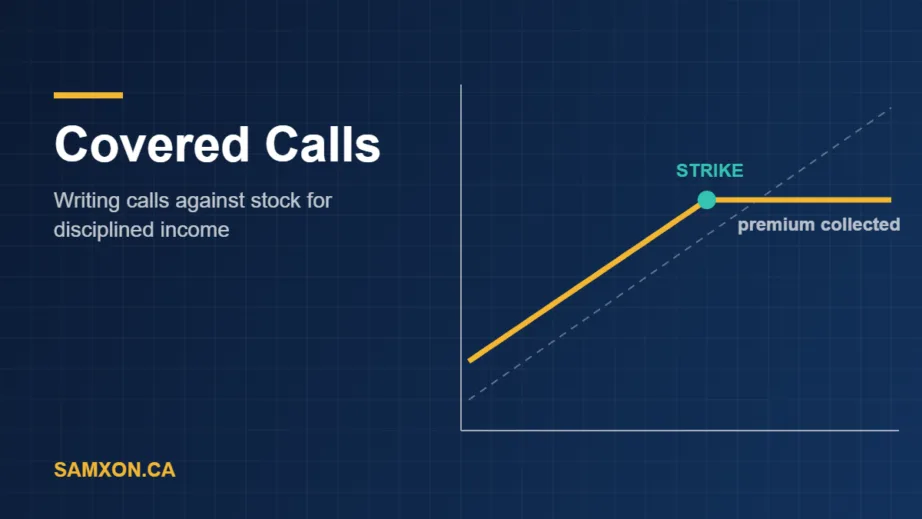
Assume a portfolio owns shares at $80 and writes a $90 call for $2. The premium supplies an immediate $2 cash inflow. Economically, it provides a small cushion against losses and reduces the net capital committed to the combined position. If shares rally materially above $90, however, the portfolio has surrendered upside beyond the strike during the option’s life. The appropriate benchmark is therefore not the premium in isolation but the return of the covered position compared with retaining unconstrained equity exposure.
Option premiums are sometimes described informally as a synthetic dividend because they create portfolio cash flow without requiring the company to increase its distribution. The analogy has limits. A dividend arises from corporate capital allocation; an option premium is compensation for assuming contractual risk. Accounting and tax treatment can also differ materially. For analytical purposes, periodic premiums may reduce the economic cost basis of a successful long-term overlay, but investors should not confuse this portfolio-level cash flow with recurring FCF generated by the underlying business.
Cost-Basis Reduction and Margin of Safety
Understanding put options and covered calls together illustrates two forms of disciplined cost-basis management. A cash-secured put can establish an effective acquisition price below the strike by the premium received. After ownership is established, selectively written covered calls can produce additional cash flows. Over multiple cycles, retained premiums can reduce net capital committed to the holding.
Suppose an institution wants exposure to a utility at an intrinsic-value estimate of $65 while the shares trade at $60. It writes a $55 put and receives $2. If assigned, the approximate economic entry price becomes $53 before expenses and taxes. If the underlying fundamentals remain intact, that entry level increases the estimated valuation margin of safety. Subsequent covered calls could further modify the return profile, but each call also creates an opportunity cost if the shares appreciate beyond the strike.
Understanding put options also means recognizing path dependency. Premium collection can appear consistently successful during calm markets before a single severe decline produces losses exceeding years of premiums. Institutional risk systems therefore assess aggregate delta, gamma, vega, liquidity and scenario exposure instead of treating each premium receipt as an isolated gain.

The Maple Perspective: Duration, Liquidity and Core Assets
The so-called Maple 8 are frequently studied for their long horizons, internal investment capabilities and large allocations to private and real assets. Their portfolios can include infrastructure with decades-long useful lives, regulated utilities, transportation assets and other investments whose economic duration can align with pension obligations. It would be inappropriate to claim that every Canadian pension plan systematically deploys covered calls or written puts against such holdings without strategy-specific disclosure. The more durable lesson is their focus on managing exposures at the total-portfolio level.
Synthetic overlays can, where mandates and liquidity permit, modify cash flows or market exposures without forcing an investor to dispose of strategically important assets. A portfolio may use equity derivatives, currency hedges, interest-rate instruments or option structures to alter risk while preserving underlying ownership. This can matter when selling a core infrastructure position would create transaction costs, governance complications, tax consequences or unwanted disruption of long-duration cash flows.
Understanding put options fits this framework because puts can separate part of market-price risk from ownership. Protective puts can impose a temporary floor; put spreads can reduce hedging cost in exchange for limited protection; and written puts can represent conditional commitments to deploy capital at predetermined valuations. None is universally optimal. The strategy depends on liability needs, liquidity reserves, valuation and the cost of volatility.
Dividend Sustainability in Capital-Intensive Businesses
A pension-oriented investor should distinguish a high stated dividend yield from a sustainable distribution. Consider a company reporting $1 billion of net income and paying $700 million in dividends. A 70% accounting payout ratio may initially appear manageable. If operating cash flow is $1.5 billion but required CapEx is $1.0 billion, however, simplified FCF is only $500 million. The dividend exceeds that amount by $200 million, potentially requiring incremental debt, asset sales or balance-sheet cash.
The analysis becomes more nuanced if a substantial portion of CapEx is discretionary growth investment expected to earn attractive regulated or contracted returns. Analysts should therefore normalize capital requirements rather than mechanically penalize every dollar invested. Understanding put options does not eliminate this work: strike prices should incorporate realistic estimates of sustainable owner cash flow, leverage capacity and reinvestment needs.
For leveraged infrastructure and utility businesses, interest rates also connect macroeconomic conditions with bottom-up valuation. Higher rates can increase refinancing costs, lower the present value of distant cash flows and pressure equity valuations. At the same time, market stress can lift IV. An apparently rich put premium might therefore be compensation for a genuine deterioration in financing conditions rather than an exploitable pricing anomaly.
Compounding Across Multi-Decade Horizons
Compounding is central to pension investing because relatively modest differences in annualized return become significant over decades. At a constant annual return r over n years, wealth grows by the factor (1+r)^n. For illustration, $100 compounded at 7% for 30 years becomes approximately $761 before taxes, costs and other frictions. At 6%, it becomes roughly $574. A persistent one-percentage-point return difference therefore has substantial long-horizon consequences.
Dividend reinvestment plans, or DRIPs, can reinforce this mechanism by using distributions to purchase additional shares, which subsequently participate in future dividends and capital appreciation. But sustainable compounding depends on business economics. Reinvesting a dividend from a company funding that dividend through excessive leverage is fundamentally different from reinvesting cash distributed by a company with durable FCF and prudent capital allocation.
Understanding put options introduces another compounding consideration: hedging and overlays affect geometric return. Repeated protective-put purchases can reduce catastrophic drawdowns but create recurring premium costs. Covered-call writing can improve outcomes in flat or moderately appreciating markets but lag sharply rising equities because gains are capped. A successful institutional program therefore optimizes the total return profile rather than maximizing the amount of premium collected in any particular year.
Upside Caps, Current Cash Flow and Total Return
The principal trade-off in a covered-call overlay is explicit. The portfolio receives premium today in return for transferring some future upside to the call buyer. That can be sensible where expected appreciation is modest, valuation is full and IV provides attractive compensation. It can be costly when a fundamentally undervalued company enters a powerful rerating cycle.
Understanding put options involves a parallel trade-off. The buyer transfers some portfolio return through premiums to obtain convex downside protection. The writer receives current premium but accepts potentially substantial future capital obligations. Neither side receives a free improvement in expected outcomes. Each side exchanges one portion of the return distribution for another.
Institutional investors must also consider liquidity under stress. A cash-secured put strategy is genuinely cash-secured only if the capital remains available when assignment occurs. A portfolio that writes puts while implicitly relying on selling other risk assets during a crisis can encounter correlated losses and liquidity pressure. Position sizing, collateral policy and stress testing are consequently as important as option valuation.
Integrating Options With Fundamental Valuation
A disciplined process begins with the company rather than the contract. Analysts estimate normalized revenue growth, operating margins, taxes, reinvestment, FCF and capital intensity. They examine debt maturity schedules, pension liabilities, covenant constraints and management’s history of allocating capital. Only after developing a valuation range does strike selection become meaningful.
Understanding put options can then improve implementation. An investor willing to own the business below a conservative valuation threshold may use a fully collateralized written put as a conditional acquisition mechanism. An existing shareholder concerned about a defined event may consider protective puts. A long-term holder willing to exchange a portion of near-term upside for premium may consider a covered-call overlay. These structures serve different objectives and should not be conflated.
Market-price context can also complement fundamental work without replacing it. Investors studying institutional execution benchmarks may find VWAP & Anchored VWAP: The Volume-Weighted Fair Price, from Open or Any Event a useful recommended resource for understanding volume-weighted reference prices. Such tools concern market execution and price context; they do not substitute for intrinsic-value analysis.
Capital Preservation as the Governing Principle
Understanding put options at an institutional level ultimately means thinking in terms of liabilities, opportunity costs and distributions of outcomes. The objective is not to maximize option premium. It is to determine whether a derivative improves the portfolio’s expected risk-adjusted total-return profile after accounting for transaction costs, taxes, liquidity, tail risk and foregone upside.
Canadian pension investors provide a useful philosophical reference because multi-decade liabilities reward patience and rigorous capital allocation. A durable equity strategy still rests on businesses capable of converting invested capital into sustainable free cash flow while maintaining sound balance sheets. Dividends should be judged against cash generation and reinvestment requirements, particularly in capital-intensive sectors. Options sit above that foundation as overlays.
Protective puts can purchase downside convexity. Written puts can establish conditional entry points but carry genuine equity and liquidity risk. Covered calls can generate portfolio-level cash flows and modestly lower the economic cost basis while capping upside. Understanding put options therefore requires viewing every premium as compensation for a transferred risk, not as an independent source of return. For long-horizon investors, the strongest framework combines fundamental valuation, balance-sheet analysis, prudent collateral management and disciplined assessment of how each overlay changes long-term compounding.
External references: Option (finance), Put option, and Binary option.
Explore more articles in our Covered Calls section.