Understanding Expiration Dates: An Institutional Framework for Equity Options
Understanding expiration dates is essential to evaluating options as instruments of institutional capital allocation, portfolio risk management, and long-term equity ownership. For sophisticated investors, expiration is more than a contractual deadline. It determines the duration of an option’s exposure, influences premium valuation, and establishes the timing of potential changes to portfolio holdings.
Canadian pension institutions, including the Canada Pension Plan Investment Board (CPP Investments), Ontario Teachers’ Pension Plan (OTPP), and Healthcare of Ontario Pension Plan (HOOPP), provide useful frameworks for examining these decisions. Their publicly articulated investment approaches emphasize long investment horizons, diversification, risk management, and sustainable returns. Although these institutions employ sophisticated investment and risk-management techniques, specific covered-call practices should not be attributed to individual funds without supporting disclosures.
For an institutional portfolio holding dividend-paying equities, expiration selection becomes a capital allocation decision. The objective is not simply maximizing option premiums. It is determining whether the compensation received for transferring part of the portfolio’s upside exposure adequately supports the investor’s long-term total-return objectives.
1. What Is an Options Expiration Date?
An options expiration date is the contractual date associated with the end of an option’s life. It establishes the time limit within which the holder can exercise the contractual right to buy or sell an underlying security under the applicable contract rules.
A call option provides the holder with the right, but not the obligation, to purchase an underlying asset at a specified strike price. A put option provides the corresponding right to sell.
The distinction between American-style and European-style exercise is important. American-style options generally permit exercise before expiration, while European-style options permit exercise only at expiration. Settlement procedures and exercise cutoffs depend on the contract and exchange.
Understanding expiration dates also requires distinguishing an option’s stated expiration from its final trading session. These dates may differ, particularly across index options, equity options, and contracts with different settlement conventions.
For Canadian institutional investors, such operational details influence collateral planning, cash management, and the likelihood of an equity position being delivered through assignment.
Investors seeking a broader contractual foundation can review What Is Options Investing?, which provides context for understanding how options interact with underlying securities.
2. Why Expiration Dates Matter in Institutional Portfolio Management
Understanding expiration dates requires connecting contractual maturity with portfolio construction.
Large pension funds invest against liabilities extending decades into the future. Their asset allocation decisions therefore consider expected returns, liquidity requirements, interest-rate sensitivity, and the reliability of future cash flows.
Options operate over substantially shorter horizons. A covered call might expire in several weeks or months, while the underlying equity investment may remain in the portfolio for many years.
This difference creates an important distinction between strategic ownership and tactical exposure management.
Consider an institutional portfolio holding shares in a regulated Canadian utility. The investment thesis may depend on predictable electricity demand, regulated returns on capital, dividend growth, and long-lived infrastructure assets.
Writing a call option against that holding does not necessarily change the fundamental investment thesis. Instead, it temporarily modifies the portfolio’s payoff distribution.
The institution receives an option premium in exchange for surrendering some potential appreciation above the strike price during the contract’s life.
Expiration determines how long that upside limitation remains effective.
A short-dated contract limits the commitment period but requires more frequent decisions. A longer-dated contract may provide a larger upfront premium while restricting upside participation for a longer interval.
Consequently, expiration selection should reflect the desired balance between current premium receipts, future equity participation, transaction costs, and operational complexity.
3. Covered Calls as a Long-Term Equity Overlay
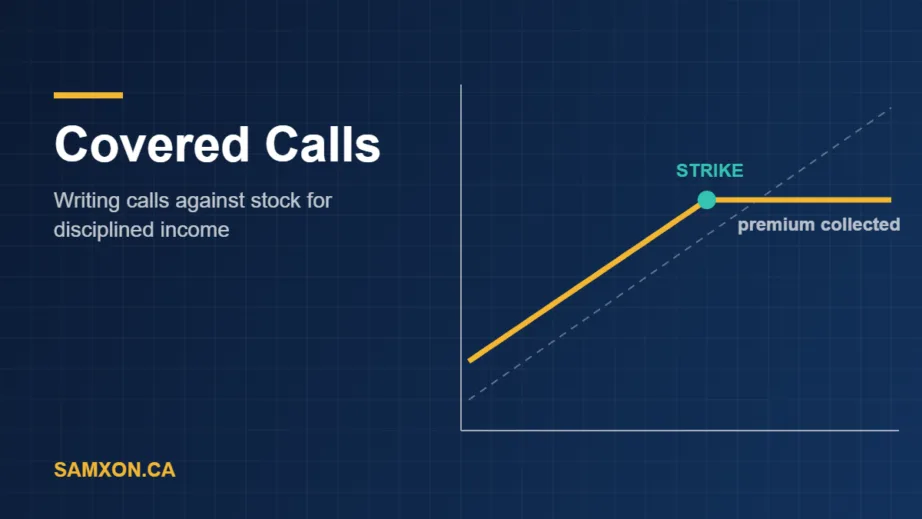
A covered call combines ownership of an underlying security with the sale of a call option against that position.
The strategy is considered covered because the investor already owns sufficient shares to satisfy delivery obligations under the written option.
For an institutional portfolio, this structure can function as an equity overlay rather than a separate directional investment strategy.
The central objective is to modify the return distribution of an existing investment without immediately liquidating the underlying position.
Example: A Canadian Utility Holding
Assume a portfolio owns 10,000 shares of a hypothetical utility company.
- Current share price: $50.
- Original acquisition cost: $46 per share.
- Annual dividend: $2.00 per share.
- Call strike price: $55.
- Time until expiration: 45 days.
- Option premium received: $1.00 per share.
- Shares represented by the written calls: 10,000.
Assuming a standard contract multiplier of 100 shares, the portfolio writes 100 covered-call contracts and receives $10,000 in gross premiums.
The premium represents 2% of the current $500,000 market value of the shares.
However, that 2% receipt should not be interpreted as a guaranteed recurring return. Future option premiums depend on market prices, volatility, strike selection, and remaining time to expiration.
If the shares remain below $55 through expiration and the calls expire unexercised, the portfolio retains the shares and the gross premium.
If the shares rise substantially above $55, the calls may be exercised and the shares assigned at the strike price.
In the assignment scenario, the investor receives $55 per share plus the previously collected $1 premium, producing $56 per share before transaction costs and taxes.
The economic cost is the upside forfeited above the strike price.
A stock price of $65 would create a meaningful difference between the covered-call portfolio and an otherwise identical portfolio without the overlay.
The institutional question is whether the premium adequately compensates for that foregone appreciation.
For additional implementation context, Writing Covered Calls: How to Turn Your Stocks Into Steady Income examines the relationship between stock ownership and option premium collection.
4. Understanding Expiration Dates and Time Decay
One of the most important characteristics of an option is that its time value generally declines as expiration approaches, assuming other pricing inputs remain unchanged.
This process is commonly described using theta, an option Greek measuring sensitivity to the passage of time.
Options generally contain two components of value: intrinsic value and extrinsic value.
Intrinsic value reflects the immediate economic benefit available through exercise, subject to the contract’s characteristics.
Extrinsic value reflects factors such as remaining time, expected volatility, interest rates, and anticipated distributions.
Understanding expiration dates is therefore closely connected to understanding how much compensation a call writer receives for accepting temporary upside limitations.
Short-Dated Expiration
Short-dated options often exhibit faster time-value decay near expiration, particularly when their strikes are close to the underlying share price.
This can make shorter maturities attractive for systematic premium collection.
However, accelerated theta does not eliminate market risk. Near expiration, at-the-money options can also exhibit substantial gamma, meaning their delta changes rapidly as the underlying price moves.
For institutions, this creates potential turnover and assignment-management challenges.
Long-Dated Expiration
Longer-dated options generally contain greater absolute time value because more time remains for the underlying security to move.
Nevertheless, premium received per calendar day may be lower than for certain shorter-dated alternatives.
Longer maturities also extend the period during which the portfolio’s upside is constrained.
A fund expecting significant fundamental appreciation from earnings growth, infrastructure investment, or regulatory developments may prefer to preserve greater participation in that appreciation.
Expiration selection is consequently an optimization problem involving premium, volatility exposure, expected returns, and the investor’s willingness to relinquish upside.
5. Implied Volatility and Institutional Risk Compensation
Implied volatility, or IV, represents the volatility level embedded in an option’s market price under a specified valuation model.
It is not a direct forecast of future realized volatility. Rather, it is the volatility assumption consistent with observed option prices and the model’s other inputs.
Understanding expiration dates requires examining implied volatility across different maturities.
This relationship is known as the volatility term structure.
During periods of economic uncertainty, near-term implied volatility may rise sharply as investors seek protection against immediate market fluctuations.
At other times, longer-dated options may exhibit higher implied volatility than shorter-dated contracts.
For an institutional covered-call program, elevated implied volatility can increase the premiums available from selling calls.
However, larger premiums are not automatically attractive.
Higher implied volatility may indicate increased uncertainty surrounding earnings, financing conditions, economic growth, or regulatory policy.
Writing calls during such periods effectively sells a portion of the portfolio’s upside volatility exposure.
The investor receives compensation for accepting an asymmetric payoff: limited participation in large upward moves while retaining substantial downside exposure to the underlying shares.
For this reason, covered calls should not be represented as comprehensive downside protection.
The premium provides only a limited initial cushion against share-price declines.
If a stock declines from $50 to $35 after a $1 premium is received, the covered-call position still experiences a substantial economic loss.
Volatility Risk Premium
Institutional option programs frequently evaluate the relationship between implied volatility and subsequently realized volatility.
When implied volatility exceeds realized volatility over comparable periods, option sellers may receive compensation for bearing volatility risk.
This difference is commonly associated with the volatility risk premium.
However, it is neither constant nor guaranteed.
Periods of sudden market repricing can produce realized volatility exceeding the levels previously implied by option prices.
Furthermore, the return on a covered call depends on the underlying equity’s direction, the option’s strike, its maturity, and changes in implied volatility.
Institutional evaluation therefore requires scenario analysis rather than relying exclusively on historical premium averages.
6. Option Premiums and Effective Cost-Basis Reduction
One reason covered calls attract interest among long-term equity holders is their potential to improve the economic recovery of invested capital.
Understanding expiration dates becomes particularly relevant when assessing how repeated premium receipts accumulate across successive option cycles.
Suppose an investor acquires shares at $50 and subsequently receives $1 per share from writing a covered call.
For analytical purposes, the investor may describe the position as having an effective net capital exposure of $49 per share.
If the investor later collects another $0.75 per share, cumulative gross premiums reach $1.75, reducing this simplified economic measure to $48.25.
This is sometimes described as synthetic dividend income or economic cost-basis reduction.
Nevertheless, an important distinction is necessary.
Option premiums do not automatically reduce the legal or tax-adjusted cost base of the underlying shares. Canadian tax treatment depends on the circumstances, including whether the option expires, is closed, or is exercised, and whether the activity is treated on capital or income account.
Accordingly, economic cost-basis reduction is best understood as a performance-accounting concept rather than a universal tax treatment.
Premiums Are Not Corporate Dividends
A dividend is a distribution made by a corporation to its shareholders.
A call premium is compensation received from another market participant for assuming a contractual obligation.
The distinction matters for institutional capital preservation.
Corporate dividends may reflect sustainable operating cash flows, while option premiums reflect market pricing of risk.
Both can contribute to portfolio cash receipts, but they originate from different economic mechanisms.
Repeated call writing also creates cumulative upside opportunity costs that should be measured against the premiums collected.
Consequently, a lower effective economic cost basis does not necessarily imply superior total-return performance.
7. The Maple 8 Perspective: Asset Duration and Capital Allocation
Canada’s major public pension investors, often discussed collectively as the Maple 8, operate under long-duration investment mandates that differ substantially from those of short-horizon investors.
Institutions such as CPP Investments, OTPP, and HOOPP evaluate assets based on expected long-term returns, diversification, liquidity, and their contribution to portfolio-wide risk.
Infrastructure, utilities, real estate, private equity, and public equities can serve different functions within these portfolios.
Infrastructure and regulated utilities are particularly relevant because their cash flows may extend across decades.
These assets can also require substantial ongoing capital investment.
For an institution managing long-term obligations, liquid public-equity overlays may offer a way to adjust portfolio exposures without immediately changing strategic allocations.
For example, an institution might hypothetically maintain ownership of a listed utility while writing calls against a portion of the position.
The resulting premium could supplement portfolio liquidity while leaving uncovered shares available for future capital appreciation.
However, this should not be confused with generating option premiums directly from private infrastructure assets.
Privately held infrastructure investments generally lack the standardized, liquid listed options necessary for conventional covered-call implementation.
Any synthetic overlay associated with such exposures would require separate instruments, basis-risk analysis, and appropriate governance.
Understanding expiration dates is especially important because short-term option maturities cannot independently match pension obligations extending decades into the future.
Rather, overlays can contribute to liquidity and return management within a broader asset-liability framework.
8. Corporate Fundamentals: Free Cash Flow Versus Net Income
A covered-call overlay cannot compensate indefinitely for deteriorating corporate fundamentals.
The durability of the underlying equity remains the foundation of long-term portfolio performance.
For dividend-oriented investors, free cash flow provides an essential complement to reported net income.
Net income is calculated under accrual accounting and includes noncash expenses, financing effects, and accounting estimates.
Free cash flow is commonly approximated as operating cash flow minus capital expenditures.
Although definitions vary, this measure helps identify cash remaining after investment in the business.
Example: A Capital-Intensive Utility
Consider a hypothetical regulated utility reporting the following annual financial results:
- Net income: $2.0 billion.
- Operating cash flow: $3.5 billion.
- Capital expenditures: $2.8 billion.
- Free cash flow: $700 million.
- Common dividends paid: $1.2 billion.
The earnings-based dividend payout ratio is 60%, calculated by dividing $1.2 billion in dividends by $2.0 billion in net income.
On the surface, that appears manageable.
However, the free-cash-flow payout ratio is approximately 171%, calculated as $1.2 billion divided by $700 million.
The company is distributing more cash than its simplified free-cash-flow measure generates.
That does not automatically make the dividend unsustainable.
Utilities frequently operate with major construction programs that require financing before new assets enter the regulated rate base.
Investment-grade borrowing, retained earnings, equity issuance, and regulatory cost recovery may support these programs.
Nevertheless, persistent financing requirements deserve careful attention.
Institutional analysis should distinguish maintenance capital expenditures from growth capital expenditures, evaluate regulatory recovery mechanisms, and assess the timing of projected cash flows.
Balance Sheet Considerations
Important financial indicators include net debt relative to EBITDA, interest coverage, debt maturity schedules, available liquidity, and the weighted-average cost of capital.
Higher interest rates can pressure utility valuations by increasing financing costs and reducing the present value of future cash flows.
They can also affect option valuations through changes in forward prices and the broader market’s assessment of volatility.
For covered-call investors, this creates an important connection between bottom-up financial analysis and macroeconomic conditions.
A premium that appears attractive in isolation may be insufficient compensation for deterioration in the underlying company’s balance sheet.
9. Interest Rates, Inflation, and Expiration Selection
Understanding expiration dates also requires evaluating the macroeconomic environment in which options are priced.
Interest rates influence the present value of option payoffs, forward equity prices, and corporate financing conditions.
Inflation affects operating margins, wage expenses, financing requirements, and the purchasing power of future distributions.
For regulated utilities, inflation may eventually be reflected in approved tariffs or allowed returns, although regulatory adjustments can occur with delays.
Changes in bond yields also influence the relative attractiveness of dividend-paying equities.
When government bond yields rise, investors may demand higher expected returns from utility shares, potentially placing downward pressure on valuations.
At the same time, uncertainty surrounding monetary policy can increase implied volatility.
An institution evaluating a covered-call overlay must therefore consider both effects: the premium available from writing options and the changing fundamental valuation of the underlying company.
Shorter expirations provide opportunities to reassess exposures as economic information changes.
Longer expirations may reduce operational turnover but create extended periods of limited upside participation.
Neither maturity is universally superior.
10. Dividend Reinvestment and Multi-Decade Compounding
For pension investors, the mathematical foundation of long-term wealth accumulation is total-return compounding.
Dividends, earnings growth, valuation changes, and reinvestment decisions all influence the result.
A simplified compounding relationship is:
Future portfolio value = Initial investment × (1 + annual total return)^number of years.
Assume a portfolio begins with $1 million and achieves an annualized total return of 7% over 25 years.
Under a constant-return assumption, the ending value would be approximately $5.43 million.
At 6%, the corresponding value would be approximately $4.29 million.
A difference of one percentage point annually therefore produces a substantial difference over a multi-decade horizon.
This highlights the importance of evaluating option overlays through total returns rather than premium receipts alone.
Dividend Reinvestment Plans
A dividend reinvestment plan, commonly called a DRIP, uses cash dividends to acquire additional shares.
Reinvestment can increase the number of shares owned, allowing subsequent dividends to be received on a larger position.
Over long periods, this mechanism can materially support compounding.
However, covered calls can interfere with that process if shares are assigned during periods of strong appreciation.
The investor may then need to reacquire shares at higher prices to restore the original exposure.
Transaction costs, taxes, and market movements can reduce the benefits of the premiums previously received.
Understanding expiration dates is therefore important for coordinating option maturities with dividend schedules and long-term reinvestment policies.
11. Ex-Dividend Dates and Early Assignment Risk
Dividend-paying equities introduce an additional consideration for covered-call overlays: early assignment risk.
American-style calls may be exercised before expiration.
This becomes particularly relevant around an ex-dividend date when a call is in the money and its remaining extrinsic value is low relative to the forthcoming dividend.
Under these circumstances, early exercise may be economically attractive to the call holder.
The covered-call writer could consequently lose ownership of the underlying shares before receiving the next dividend.
For institutional investors, this can disrupt planned dividend receipts, portfolio weights, and tax-sensitive investment decisions.
Expiration selection should therefore account for corporate distribution calendars rather than treating dividends and options as independent sources of cash flow.
The value of a covered-call strategy must incorporate the possibility of missed dividends following assignment.
12. Choosing Between Weekly, Monthly, and Longer Expirations
Understanding expiration dates involves comparing the economic characteristics of different maturity structures.
Weekly Expirations
Weekly options provide frequent opportunities to adjust strikes and exposure.
They can also create substantial operational demands, particularly for large portfolios where liquidity and transaction costs matter.
Near-expiration gamma sensitivity may increase the frequency of required decisions.
Monthly Expirations
Monthly contracts often provide a practical balance between liquidity, premium availability, and portfolio monitoring.
Nevertheless, actual market depth varies across securities and exchanges.
Institutions must consider bid-ask spreads, available open interest, market impact, and the ability to execute at acceptable prices.
Quarterly and Longer Expirations
Longer maturities can reduce the frequency of option-writing decisions and provide greater upfront premium receipts.
They also create longer commitments to the selected strike price.
For companies with substantial expected earnings growth, this can represent a significant opportunity cost.
A disciplined overlay program should select maturities based on portfolio objectives rather than simply choosing whichever contract offers the largest quoted premium.
13. Measuring Covered-Call Performance
Institutional evaluation should measure a covered-call overlay against an appropriate benchmark, typically the same underlying equity portfolio without the overlay.
Relevant performance measures include total return, volatility, maximum drawdown, upside capture, downside capture, and risk-adjusted returns.
Premium receipts should be combined with changes in equity value and the economic effects of assignment or closing transactions.
Understanding expiration dates also helps explain why annualizing a single short-term option premium can produce misleading conclusions.
For example, receiving 2% over 45 days does not establish that the investor can repeatedly earn the same amount throughout a year.
Future premiums may decline, underlying share prices may change, and assignments may prevent continuous ownership.
Transaction costs and taxes further affect realized results.
Strike Selection and Upside Participation
Strike price selection is as important as expiration selection.
Calls written close to the current share price generally offer greater premiums but constrain appreciation sooner.
Further out-of-the-money calls typically provide smaller premiums while preserving more potential upside.
Institutions may evaluate these alternatives using option delta, expected return distributions, and portfolio-level risk limits.
Delta can serve as a practical measure of an option’s sensitivity to changes in the underlying share price, although it should not be interpreted as a guaranteed probability of assignment.
Because implied volatility and time to expiration influence delta, strike selection and maturity selection should be evaluated together.
14. Liquidity, Market Participation, and Execution Quality
Large institutional portfolios face execution constraints that may be insignificant for smaller positions.
A quoted option premium is not necessarily the price available for a substantial transaction.
Bid-ask spreads, order-book depth, underlying share liquidity, and market-maker inventory can all affect execution quality.
These factors become especially important during periods of elevated volatility.
For a portfolio writing calls against millions of dollars in equity exposure, execution costs can materially reduce the expected benefit of the overlay.
Understanding expiration dates must therefore be combined with an assessment of liquidity across the option chain.
High trading volume can indicate greater market participation, but volume alone does not establish institutional conviction or guarantee favorable execution.
Relative volume, price response, and changes in open interest may provide additional context when assessing market conditions.
For readers examining these relationships, Volume & Relative Volume: Participation, Conviction, and What’s Behind the Move is a recommended resource focused on interpreting trading activity and participation.
15. Capital Preservation and the Limits of Covered Calls
Covered calls can improve portfolio outcomes in certain sideways, moderately rising, or declining markets.
The premium collected provides a limited cushion against losses and may reduce realized return volatility under some conditions.
However, the strategy introduces meaningful trade-offs.
Strong equity rallies can leave the covered-call portfolio materially behind an uncovered equity benchmark.
Large market declines remain damaging because the investor continues to own the underlying shares.
Furthermore, systematic option writing can create repeated transaction costs and tax consequences.
Understanding expiration dates is central to managing these trade-offs because maturity determines how long the asymmetric payoff remains in force.
For an institution focused on capital preservation, the relevant objective is not the elimination of risk.
It is the deliberate allocation of risk within a portfolio capable of meeting long-term obligations.
A covered-call overlay may be appropriate when expected premium compensation justifies reduced upside participation and when the underlying equity remains fundamentally attractive.
It may be less suitable when the investment thesis depends heavily on substantial capital appreciation.
16. Integrating Expiration Selection With Fundamental Valuation
A robust institutional process begins with the underlying company’s intrinsic value rather than the option chain.
Analysts first assess revenue durability, operating margins, reinvestment requirements, financing costs, and expected free cash flow.
They then estimate the value of future cash flows using assumptions consistent with the company’s risk profile and capital structure.
For a utility, this may involve evaluating regulated asset growth, allowed returns on equity, debt financing, and the timing of capital expenditure recovery.
Only after establishing the investment case should the portfolio manager determine whether selling upside exposure offers attractive compensation.
Understanding expiration dates then becomes part of implementing that decision.
If a company trades materially below estimated intrinsic value, writing near-the-money calls may be inconsistent with the objective of capturing valuation recovery.
Conversely, when the share price approaches a defensible valuation estimate, selective call writing may provide compensation for reducing exposure to further appreciation.
This approach connects fundamental valuation with derivative pricing while preserving the distinction between long-term ownership and short-term portfolio overlays.
17. Governance and Risk Controls for Institutional Overlays
Institutional option programs require explicit governance standards.
These typically include limits on the percentage of holdings subject to calls, approved maturities, strike-selection parameters, counterparty exposure, and liquidity requirements.
Portfolio managers should also monitor the effects of potential assignment on sector weights and strategic allocations.
Understanding expiration dates supports this process by identifying when contractual obligations terminate, may be exercised, or require further decisions.
For exchange-traded options, clearing arrangements reduce certain bilateral counterparty risks but do not eliminate market, liquidity, operational, or settlement risks.
Stress testing should examine substantial upward and downward equity movements, implied-volatility changes, and periods of reduced market liquidity.
Performance attribution should separately identify dividends, underlying equity returns, option premiums, option settlement results, and transaction costs.
Such controls help prevent premium collection from becoming an isolated performance objective disconnected from the institution’s broader investment mandate.
Conclusion: Expiration Dates as a Capital Allocation Decision
Understanding expiration dates is fundamental to evaluating covered calls within a disciplined institutional investment framework.
Expiration determines the duration of upside restrictions, the evolution of time value, assignment considerations, and the frequency of portfolio decisions.
For long-horizon investors influenced by the capital allocation principles of Canada’s major pension institutions, options should remain subordinate to the quality and valuation of the underlying assets.
Strong balance sheets, sustainable free cash flow, disciplined capital expenditure, and durable competitive advantages remain the primary foundations of long-term returns.
Covered-call overlays can modify those returns by providing premium compensation in exchange for limited upside participation.
They may improve certain risk-adjusted outcomes, but they cannot transform fundamentally weak businesses into sound long-term investments.
Ultimately, understanding expiration dates allows institutional and private wealth investors to evaluate whether an option’s maturity, premium, and strike price align with the portfolio’s required total-return profile, liquidity needs, and multi-decade capital preservation objectives.
Additional technical context on option contracts and maturity structures is available through Option (finance) and Options strategy.
Related reading on Samxon
Sources and further reading
Explore more articles in our Covered Calls section.