Understanding Intrinsic Value vs Extrinsic Value in Institutional Investing
The distinction between intrinsic value vs extrinsic value is fundamental to understanding how sophisticated investors assess equity ownership, derivative contracts, and long-term capital allocation. Although these concepts appear in both fundamental valuation and options analysis, their definitions differ depending on the financial instrument being evaluated.
For equity investors, intrinsic value represents an estimate of the economic worth of a business based on its expected future cash flows, competitive position, reinvestment requirements, and cost of capital. For options investors, intrinsic value has a narrower contractual meaning: the amount by which an option is in the money. Extrinsic value represents the remaining portion of the option premium attributable primarily to time, expected volatility, and other pricing variables.
Understanding these distinctions is particularly relevant to institutional investment strategies associated with major Canadian pension organizations, including CPP Investments, Ontario Teachers’ Pension Plan (OTPP), and Healthcare of Ontario Pension Plan (HOOPP).
These institutions operate within long-duration investment frameworks in which capital preservation, liquidity management, asset-liability matching, and sustainable compounding are central considerations. Their approaches provide a useful framework for evaluating how fundamental equity ownership and derivative overlays can complement one another.
Importantly, the following discussion uses institutional investment principles to illustrate portfolio construction. It does not imply that any named pension organization currently implements the particular covered-call strategies or allocation examples described.
Intrinsic Value in Fundamental Equity Analysis
The Economic Value of a Business
In fundamental analysis, intrinsic value represents the present value of the future economic benefits attributable to an investment.
For an operating company, these benefits are generally measured through expected free cash flow, adjusted for business risk, capital structure, and the opportunity cost of capital.
A common institutional valuation approach is discounted cash flow analysis:
Enterprise Value = Σ [FCFF(t) / (1 + WACC)^t] + Terminal Value / (1 + WACC)^N
Where FCFF represents free cash flow to the firm, WACC represents the weighted average cost of capital, and N represents the explicit forecasting period.
Equity value is subsequently estimated by adjusting enterprise value for net financial obligations and other claims, with the resulting value divided by diluted shares outstanding.
This framework recognizes that market price and economic value are not necessarily identical.
A profitable utility company, for example, may trade below its estimated intrinsic value because rising interest rates increase its financing costs and reduce the present value of future cash flows.
Conversely, the same company may trade above reasonable valuation estimates when investors assign unusually high premiums to its perceived earnings stability.
Institutional investors therefore distinguish between price movements caused by changing fundamentals and movements driven primarily by market sentiment.
Free Cash Flow and Capital Intensity
For long-duration investors, earnings quality is often more informative than reported net income alone.
Net income incorporates accrual accounting, depreciation, deferred taxes, and other noncash adjustments. Free cash flow measures the cash remaining after operating requirements and capital expenditures.
A simplified calculation is:
Free Cash Flow = Operating Cash Flow − Capital Expenditures
Consider a regulated infrastructure company reporting the following hypothetical annual results:
- Net income: $1.2 billion.
- Operating cash flow: $2.0 billion.
- Capital expenditures: $1.5 billion.
- Free cash flow: $500 million.
- Common dividends: $700 million.
The accounting dividend payout ratio equals approximately 58%, suggesting manageable distributions when measured against net income.
However, the free cash flow payout ratio equals 140%.
This difference matters because infrastructure operators frequently require substantial ongoing investment in maintenance, system reliability, capacity expansion, and regulatory compliance.
A payout exceeding current free cash flow is not automatically unsustainable. Growth expenditures may support future regulated earnings, and established operators can finance investment through appropriately structured debt and equity issuance.
Nevertheless, persistent funding gaps require examination of leverage, financing costs, capital market access, and the expected returns on incremental investment.
For investors following the capital discipline associated with Canada’s major pension funds, sustainable distributions must ultimately be supported by economic cash generation rather than accounting profitability alone.
Intrinsic Value vs Extrinsic Value in Options Contracts
Contractual Intrinsic Value
In options valuation, intrinsic value has a precise mathematical definition that differs from the estimated fundamental value of a company.
For a call option:
Call Intrinsic Value = Maximum(Stock Price − Strike Price, 0)
For a put option:
Put Intrinsic Value = Maximum(Strike Price − Stock Price, 0)
Intrinsic value therefore measures the immediate exercise value of an option, without considering transaction costs or the economic disadvantages of early exercise.
Consider a stock trading at $105 with a call option carrying a $100 strike price.
The call possesses $5 of intrinsic value because exercising the contractual purchase right would permit acquisition at $100 when the underlying security trades at $105.
If the same call trades for $8, the remaining $3 represents extrinsic value.
Option Premium = Intrinsic Value + Extrinsic Value
This relationship is central to understanding intrinsic value vs extrinsic value in derivative pricing.
Investors seeking additional contract-level context can review the fundamental structure and obligations of an option contract.
What Creates Extrinsic Value?
Extrinsic value reflects the amount investors are willing to pay beyond immediate exercise value for the economic possibilities remaining before expiration.
Its principal determinants include time to expiration, implied volatility, interest rates, expected dividends, and the relationship between the strike price and underlying market price.
Longer-dated contracts generally contain greater time value because the underlying security has more opportunity to experience a significant price movement.
Higher implied volatility generally increases option premiums because a wider distribution of potential future prices increases the value of optionality.
For dividend-paying securities, expected distributions also influence option valuation and early-exercise incentives.
Extrinsic value is not equivalent to fundamental investment value. It is a market price for contingent contractual exposure.
This distinction prevents a common analytical error: confusing an attractive option premium with an attractive underlying investment.
A fundamentally impaired business can exhibit expensive options because of uncertainty surrounding its future price.
Institutional capital allocation should therefore begin with asset quality and valuation rather than premium availability.
The Institutional Covered-Call Overlay
Separating Core Ownership From Derivative Exposure
A covered-call overlay involves maintaining ownership of an underlying equity position while writing call options against some or all of that exposure.
The investor receives an option premium in exchange for granting another market participant the right to acquire the underlying shares at the contractual strike price.
For sophisticated long-term investors, this structure is best understood as a modification of the portfolio’s return distribution.
The underlying equity remains the primary source of economic exposure. The derivative changes how gains and losses are distributed across possible market outcomes.
The strategy can be expressed as:
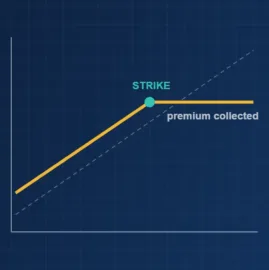
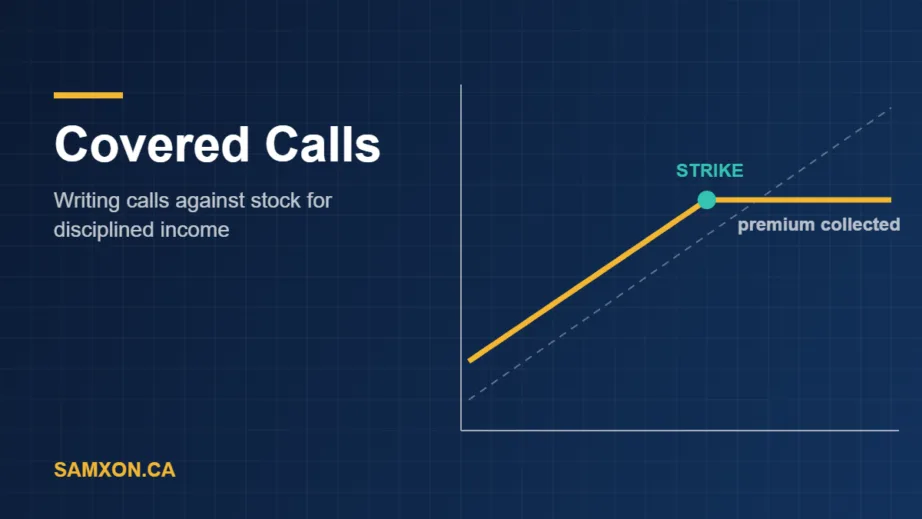
Covered-Call Position = Long Equity + Short Call Option
At expiration, assuming the shares are retained until settlement and ignoring financing costs, taxes, and transaction expenses:
Covered-Call Profit = Stock Price at Expiration − Initial Stock Cost + Premium − Maximum(Stock Price at Expiration − Strike Price, 0)
This expression illustrates the central trade-off.
The option premium improves the portfolio’s return when the underlying security remains below the strike price. However, appreciation above the strike is economically surrendered.
The objective is not to maximize premium collection independently of underlying portfolio considerations.
Instead, the overlay must be evaluated against expected equity returns, valuation uncertainty, liquidity requirements, and the institution’s willingness to limit participation in substantial appreciation.
A Practical Institutional Illustration
Assume a portfolio holds 10,000 shares of a mature dividend-paying company purchased at $100 per share.
The initial position has a market value of $1 million.
The investment team estimates fundamental value at $112 per share, based on normalized free cash flow and a conservative discount rate.
Management identifies a three-month call option with a $110 strike and a premium of $2.50 per share.
Writing calls against the full position generates an initial premium of $25,000 before costs.
Three expiration outcomes illustrate the economic consequences:
- Stock finishes at $95: The calls expire without exercise. The equity position loses $50,000 in market value, partially offset by the $25,000 premium. The combined pre-dividend result is a $25,000 loss.
- Stock finishes at $105: The calls expire without exercise. The underlying position gains $50,000, and the premium increases the combined result to $75,000.
- Stock finishes at $125: The contractual payoff caps the position’s economic upside at $110 per share plus the $2.50 premium. The combined gain is $125,000, compared with $250,000 for the uncovered equity position.
These outcomes exclude dividends, trading costs, financing effects, and taxes. They also assume a European-style expiration payoff for illustration; American-style equity options can be exercised before expiration.
The example demonstrates why covered calls should be evaluated through portfolio-level scenario analysis rather than premium yield alone.
Cost-Basis Reduction and the Synthetic Dividend Concept
Understanding Economic Cost Basis
One attraction of systematic option writing is the ability to collect premiums while maintaining an underlying investment position.
These premiums can be described economically as dividend-like cash receipts because they provide current cash flow without requiring an immediate sale of shares.
However, option premiums are not corporate dividends.
Dividends represent distributions of corporate capital or earnings. Option premiums arise from selling contractual rights and accepting associated contingent obligations.
This distinction matters for financial reporting, taxation, and risk analysis.
Suppose an investor acquires shares at $100 and subsequently receives $3 per share from a covered-call overlay.
The investor’s simplified premium-adjusted economic entry amount becomes:
Premium-Adjusted Entry Amount = $100 − $3 = $97
This is an analytical measure, not necessarily the adjusted cost base recognized for Canadian tax purposes.
The actual tax treatment depends on the option transaction, subsequent exercise or expiration, investor classification, and applicable rules.
Repeated premium collection may lower the cumulative net cash committed to an investment, provided associated option obligations and realized losses are properly included.
It does not create a guaranteed reduction in investment risk or accounting cost basis.
Margin of Safety Implications
In fundamental investing, margin of safety measures the difference between a conservative estimate of intrinsic business value and the price paid.
If estimated intrinsic value equals $115 and the acquisition price equals $100, the initial valuation discount is approximately 13% when measured against estimated value.
Collecting $3 in net option premium increases the investor’s cumulative cash return and can improve the break-even position under a simplified unchanged-exposure assumption.
However, the original business valuation remains unchanged.
The premium does not improve the company’s balance sheet, competitive position, free cash flow, or return on invested capital.
Furthermore, selling a call transfers some future appreciation potential to the option purchaser.
Consequently, option premiums can improve an investor’s economic entry profile without necessarily increasing the fundamental margin of safety in the traditional value-investing sense.
Institutional investors must evaluate both effects simultaneously.
Implied Volatility and Institutional Capital Preservation
Why Implied Volatility Matters
Implied volatility represents the level of expected variability embedded in market option prices under a particular pricing model.
It is not a direct forecast of realized volatility, nor does it reliably identify the direction of future market movements.
Higher implied volatility generally increases call option premiums, all else being equal.
For an institution considering a covered-call overlay, this can make volatility exposure more highly compensated.
However, high premiums frequently coincide with deteriorating liquidity, increased macroeconomic uncertainty, or materially higher probability of large price movements.
A premium that appears attractive in percentage terms may therefore compensate the option seller for accepting substantial economic risk.
The appropriate question is whether implied volatility exceeds the institution’s defensible estimate of future realized volatility after accounting for downside exposure, transaction costs, and the opportunity cost of surrendered upside.
Selling Volatility During Market Stress
During periods of elevated market uncertainty, option premiums may increase sharply.
A long-term investor with sufficient liquidity and a well-supported fundamental valuation may consider writing calls against selected holdings when option compensation is unusually attractive.
This is sometimes described as selling volatility because the investor assumes short optionality exposure and typically exhibits negative gamma and negative vega characteristics.
Nevertheless, a covered call is not equivalent to buying portfolio insurance.
The received premium provides a limited downside cushion, but the underlying equity remains exposed to substantial losses.
For example, collecting a 4% premium does not prevent a 25% decline in the underlying stock.
The combined position would still experience a significant negative return.
Moreover, stressed markets can rebound rapidly. Short calls may then materially restrict participation in recovery.
Institutional volatility management therefore requires explicit scenario testing, strike selection, exposure limits, and continuous assessment of the underlying security’s intrinsic business value.
For implementation details, understanding how strike prices determine option obligations and payoff boundaries provides a useful foundation.
The Maple 8 Perspective: Long-Duration Capital Allocation
Asset-Liability Management Comes First
Canada’s major pension investment organizations are frequently examined as models of sophisticated long-term capital allocation.
CPP Investments, OTPP, HOOPP, and other large Canadian pension managers operate across diversified asset classes, including public equities, private equity, infrastructure, real estate, and fixed income.
Their investment mandates, liability structures, liquidity profiles, and use of derivatives differ materially.

Accordingly, there is no single Maple 8 derivative strategy.
The relevant institutional principle is that portfolio construction begins with long-term obligations rather than short-term market opportunities.
Pension investment programs must consider expected benefit-related cash requirements, funding arrangements, inflation sensitivity, liquidity reserves, and the relationship between asset returns and liabilities.
Infrastructure and utility investments can contribute long-duration economic exposure because their revenues may be supported by contracted arrangements, regulated frameworks, or essential-service demand.
However, these assets are not interchangeable with government bonds. Their cash flows remain exposed to regulatory decisions, refinancing conditions, operational performance, and capital expenditure requirements.
Synthetic Overlays and Cash Flow Duration
Derivative overlays can help institutions adjust selected portfolio exposures without immediately restructuring the underlying asset allocation.
For publicly traded utility or infrastructure-related equities, covered calls may convert part of uncertain future upside into current premium receipts.
This can change the timing and distribution of portfolio cash flows while preserving underlying share ownership until exercise or another portfolio action occurs.
Such overlays can be useful when an institution seeks to manage liquidity generation, valuation exposure, or short-horizon return asymmetry.
They cannot, however, manufacture the contractual duration characteristics of a high-quality fixed-income instrument.
Option premiums are variable, exercise can alter equity ownership, and future cash receipts depend on market conditions.
Furthermore, options written directly against privately held infrastructure assets are generally not available through the same standardized markets used for listed equities.
Any attempt to hedge private-asset exposure using public-market derivatives introduces basis risk because the hedge instrument and underlying asset may respond differently to market developments.
The institutional application is therefore best understood as selective exposure management within a broader asset-liability framework, not as a universal method for generating predictable pension cash flows.
Dividend Sustainability: Net Income Versus Free Cash Flow
Why Accounting Earnings Can Mislead
Dividend growth investing depends on the long-term capacity of a company to distribute cash without weakening its operating franchise.
A business can report increasing net income while experiencing declining free cash flow because of rising capital expenditures or working-capital requirements.
This is particularly relevant to regulated utilities, telecommunications companies, pipelines, and other capital-intensive businesses.
Investors should distinguish maintenance capital expenditures from growth expenditures whenever disclosures permit a credible separation.
Maintenance spending preserves productive capacity. Growth spending may expand future revenue and cash flow, although its economic attractiveness depends on realized returns relative to the cost of capital.
A company with temporarily negative free cash flow because of high-return expansion may remain financially sound.
By contrast, an operator funding ordinary maintenance and dividends through persistent incremental borrowing may face a deteriorating financial position.
Institutional Dividend Quality Tests
A rigorous dividend assessment should incorporate several interconnected indicators:
- Free cash flow coverage: Whether normalized cash generation supports recurring distributions.
- Leverage: Whether debt remains manageable across realistic interest-rate and earnings scenarios.
- Interest coverage: Whether operating earnings and cash flow provide adequate capacity to service financing obligations.
- Capital expenditure flexibility: Whether investment requirements can be adjusted without impairing the business.
- Return on invested capital: Whether incremental investment produces returns exceeding the relevant cost of capital.
- Dividend growth capacity: Whether distributions can increase without structurally weakening the balance sheet.
For regulated utilities, analysts must also examine allowed returns on equity, regulatory capital recovery, rate-base growth, financing assumptions, and the timing of approved tariff adjustments.
Strong reported earnings are insufficient if the company cannot finance required investment on economically sustainable terms.
The most defensible dividend-growth candidates combine durable competitive economics, disciplined reinvestment, moderate leverage, and credible free cash flow conversion.
Mathematical Compounding Across Multi-Decade Horizons
The Power of Reinvestment
Long-term institutional investing depends on compounding rather than isolated annual cash receipts.
The basic compounding relationship is:
Future Value = Initial Capital × (1 + Annual Return)^Years
Consider a hypothetical $1 million portfolio earning a constant 7% annual total return with all distributions reinvested.
After 10 years, its value would be approximately $1.97 million.
After 20 years, it would reach approximately $3.87 million.
After 30 years, the portfolio would approach $7.61 million.
These figures assume uninterrupted annual compounding, no taxes, no investment expenses, and no withdrawals. Actual investment returns vary significantly over time.
The example demonstrates why seemingly modest differences in long-term total return become economically significant across institutional investment horizons.
Dividend Reinvestment Plans
A dividend reinvestment plan, commonly called a DRIP, converts cash distributions into additional shares.
Over time, those additional shares may generate further dividends, creating a reinforcing compounding mechanism.
However, dividend reinvestment does not independently create economic value.
The long-term benefit depends on the underlying company’s ability to earn attractive returns on capital and the valuation at which additional shares are acquired.
Reinvesting dividends into persistently overvalued securities can reduce prospective returns.
Similarly, a high dividend yield is not inherently superior to a lower yield accompanied by stronger internal reinvestment opportunities.
Institutional investors therefore evaluate dividends, retained earnings, share repurchases, and capital expenditures as competing uses of corporate capital.
The governing objective is sustainable growth in per-share economic value.
Covered Calls and the Long-Term Total Return Profile
Current Premiums Versus Future Appreciation
Covered-call overlays introduce a fundamental tension between current cash receipts and future capital appreciation.
Premiums can improve returns during sideways markets or modest declines.
However, systematically selling calls may reduce participation in strong equity markets, particularly when a relatively small number of large positive periods contribute disproportionately to long-term compounded returns.
Consider a hypothetical portfolio expected to earn an 8% annualized total return over a long horizon.
If an overlay adds 2 percentage points of realized premium receipts but sacrifices 3 percentage points of equity appreciation, the resulting total return declines to approximately 7%, ignoring second-order effects.
Over 30 years, $1 million compounded at 8% grows to approximately $10.06 million.
The same capital compounded at 7% grows to approximately $7.61 million.
The difference exceeds $2.4 million.
This illustrates why gross premium collection is not an adequate measure of overlay success.
Net performance must account for foregone appreciation, realized option losses, transaction costs, taxes, and changes in portfolio risk.
When an Overlay May Be Economically Justified
A covered-call program may be reasonable when expected equity appreciation is moderate, implied volatility offers attractive compensation, and portfolio liquidity objectives justify accepting a capped return distribution.
It may be less appropriate when a high-quality business trades materially below conservatively estimated intrinsic value.
In that situation, substantial future appreciation may represent the principal investment opportunity.
Selling calls too close to the current market price could surrender precisely the upside that justified acquiring the security.
Valuation-sensitive implementation may therefore involve writing calls only against a portion of the position, selecting strikes near or above conservative fair-value estimates, or avoiding overlays when expected upside is unusually asymmetric.
Each choice involves trade-offs. Higher strikes typically provide less premium, while longer maturities extend the period during which upside participation is constrained.
Effective implementation also requires consideration of bid-ask spreads, option liquidity, dividend-related assignment risk, and the potential consequences of losing an underlying position.
Risk Management: Beyond Premium Collection
Understanding the Limits of Downside Protection
A covered call reduces initial net downside exposure by the amount of premium received, but it does not establish a protective floor beneath the portfolio.
For example, an investor holding shares at $100 and receiving a $4 call premium has a simplified expiration break-even price of $96, excluding other cash flows and costs.
If the stock declines to $70, the investor still experiences a substantial loss.
The option overlay improves the result relative to an otherwise identical uncovered equity position, but the difference is limited to the premium received.
This distinction is essential when evaluating capital preservation claims.
Covered calls are fundamentally different from protective puts, which establish contractual downside protection below a specified strike, subject to their costs and terms.
Portfolio-Level Risk Controls
Institutional implementation requires controls extending beyond individual option contracts.
Relevant considerations include concentration limits, liquidity requirements, counterparty and clearing arrangements, exercise and assignment procedures, stress testing, and exposure to correlated market movements.
The interaction between dividend schedules and American-style call exercise is especially important for dividend-paying equities.
When remaining extrinsic value becomes sufficiently small relative to the economic benefit of receiving an upcoming dividend, early exercise may become attractive to the call holder.
The covered-call writer can consequently lose the underlying shares before the anticipated dividend payment.
Portfolio managers must also monitor whether overlay exposure remains consistent with the investment thesis as market prices, implied volatility, and company fundamentals change.
An overlay that was appropriate at one valuation can become economically unattractive after a significant decline in the underlying security’s price.
Mean Reversion, Valuation Discipline, and Option Selection
Mean reversion can provide an additional analytical framework for evaluating market prices relative to historical valuation ranges and fundamental expectations.
However, historical price averages should not be confused with intrinsic business value.
A stock may appear statistically inexpensive relative to its historical trading range while its underlying free cash flow outlook has permanently deteriorated.
Conversely, a company may sustain a higher valuation multiple because its return on invested capital, balance sheet quality, or long-term growth prospects have improved.
Institutional analysis should therefore integrate technical observations with bottom-up valuation, macroeconomic conditions, and capital structure analysis.
For readers examining this relationship, Reversion to the Mean: Trend Lines, Swing Points, and the Pull Back to Balance is a recommended resource for understanding price normalization concepts. Its technical framework should be used alongside, rather than as a substitute for, fundamental valuation.
Integrating Macroeconomic Signals With Fundamental Valuation
Interest Rates, Inflation, and the Cost of Capital
The relationship between intrinsic value vs extrinsic value becomes especially important when macroeconomic conditions change.
Higher interest rates can influence both the estimated fundamental value of equities and the market valuation of option contracts.
For operating businesses, higher risk-free rates may increase WACC, reducing the present value of future cash flows.
For leveraged utilities and infrastructure businesses, refinancing costs may also increase, potentially reducing cash available for distributions.
Inflation introduces additional complexity.
Companies with contractual inflation adjustments or effective regulatory cost recovery may preserve revenue purchasing power more successfully than businesses lacking pricing flexibility.
Nevertheless, inflation can increase construction expenditures, maintenance costs, working-capital requirements, and the nominal amount of financing needed for expansion.
The net effect depends on contract design, regulatory timing, capital intensity, and financing structure.
Macro Signals and Option Premiums
Macroeconomic uncertainty may also increase implied volatility, changing the compensation available from derivative overlays.
An increase in option premiums does not necessarily imply that expected investment returns have improved.
It may instead signal a wider distribution of future outcomes or greater demand for optionality.
The disciplined institutional response is to assess business fundamentals and derivative pricing separately before evaluating their interaction.
For example, an interest-rate shock might reduce the estimated intrinsic value of a leveraged utility while simultaneously increasing its option premiums.
Writing calls solely because premiums have risen would overlook the possibility that the underlying company’s expected economic value has declined.
Conversely, if conservative valuation work indicates that the security remains attractive and implied volatility is unusually high relative to reasonable forward expectations, an appropriately limited overlay may offer a favorable incremental risk-return contribution.
Final Assessment: Intrinsic Value vs Extrinsic Value as a Capital Allocation Framework
For long-term investors, the distinction between intrinsic value vs extrinsic value is more than a technical pricing concept.
It establishes a hierarchy of investment decisions.
Fundamental intrinsic value determines whether an underlying business offers attractive prospective economic returns relative to its risks.
Option intrinsic value identifies the immediate exercise value embedded in a derivative contract.
Option extrinsic value measures the additional compensation associated with time, uncertainty, and contractual optionality.
These concepts should not be treated as interchangeable.
The institutional investment philosophy associated with major Canadian pension organizations emphasizes durable cash flows, disciplined valuation, prudent capital structures, and long-term portfolio resilience.
Within that framework, covered calls can serve as selective derivative overlays that modify the distribution and timing of returns on core equity holdings.
Premium receipts may improve near-term cash flow and provide limited downside cushioning, but they cannot replace sustainable corporate free cash flow or eliminate equity risk.
Equally important, the opportunity cost of surrendered appreciation must be evaluated over multi-decade horizons, where small differences in annualized total return can produce substantial differences in accumulated wealth.
The strongest analytical framework therefore begins with business quality, normalized free cash flow, balance sheet resilience, and conservative valuation. Only after establishing the investment case should derivative premiums, implied volatility, and strike selection enter the allocation decision.
Ultimately, institutional success is measured not by the volume of premiums collected, but by the durability of risk-adjusted total returns and the portfolio’s ability to meet long-term financial obligations.
Related reading on Samxon
Sources and further reading
- Instrumental and intrinsic value (Wikipedia)
- Intrinsic value (ethics) (Wikipedia)
- Value theory (Wikipedia)
Explore more articles in our Covered Calls section.