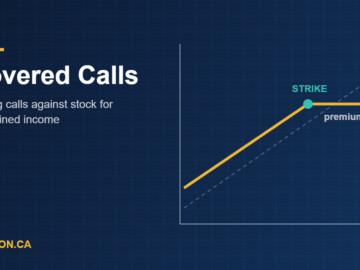
Understanding Strike Prices: The Foundation of Disciplined Options Overlays
In institutional portfolio management, understanding strike prices is essential to evaluating how options contracts can modify the risk and return characteristics of long-term equity holdings. The strike price establishes the contractual price at which an underlying security may be purchased or sold when an option is exercised. Although mechanically straightforward, its selection has significant implications for capital preservation, portfolio liquidity, opportunity costs, and long-term compounding.
For Canadian institutional investors, including the Canada Pension Plan Investment Board (CPP Investments), Ontario Teachers’ Pension Plan (OTPP), and other major pension organizations commonly associated with the Maple 8, options can form part of a broader framework for managing portfolio exposures. Derivatives may provide flexibility in adjusting market sensitivity without requiring immediate changes to underlying investments.
However, institutional practices differ considerably. Publicly available information does not establish that every major Canadian pension fund systematically writes covered calls against its equity holdings. The strategies discussed here represent potential institutional applications rather than documented policies of particular pension organizations.
The central analytical question is not simply which strike price produces the largest option premium. It is whether a particular strike price improves the expected total return profile of a fundamentally sound portfolio after accounting for valuation, volatility, transaction costs, taxation, and the possibility of surrendering future appreciation.
What Is a Strike Price?
A strike price, also called an exercise price, is the predetermined transaction price specified in an options contract. It determines the price at which the option holder may exercise the contractual right to purchase or sell the underlying asset, subject to the contract’s exercise provisions.
Understanding strike prices begins with distinguishing between the two principal option structures:
- Call options: Give the holder the right, but not the obligation, to purchase an underlying asset at the specified strike price.
- Put options: Give the holder the right, but not the obligation, to sell an underlying asset at the specified strike price.
The option seller assumes the corresponding contractual obligation if the option is exercised and assignment occurs.
For investors seeking a broader explanation of these contractual relationships, Samxon’s discussion of how option contracts function provides useful foundational context.
Consider a Canadian utility company trading at $100 per share. A call option with a $110 strike gives its holder the right to purchase shares at $110 before or at expiration, depending on whether the contract follows American-style or European-style exercise rules.
If the underlying stock appreciates to $120, the call possesses $10 of intrinsic value. If the stock remains below $110, the call has no intrinsic value, although it may retain time value before expiration.
For covered-call writers, this relationship is reversed economically. The premium received compensates the investor for accepting a contractual obligation that may limit participation in appreciation above the strike.
Strike Prices and Fundamental Equity Valuation
Institutional investors should not select strike prices independently of the underlying company’s intrinsic value. A strike price is a contractual threshold, not an estimate of fair value.
Fundamental analysis therefore establishes the economic foundation for an options overlay.
Free Cash Flow and Intrinsic Value
A company’s intrinsic value reflects the present value of cash flows available to its capital providers, adjusted for financial obligations and other relevant claims.
For a simplified discounted cash flow model:
Enterprise Value = Present Value of Forecast Free Cash Flows + Present Value of Terminal Value.
Equity value can then be estimated by adjusting enterprise value for net debt and other non-equity claims.
Suppose an infrastructure company trades at $100 while a fundamental valuation model estimates intrinsic equity value at $118 per share.
A covered call written at a $105 strike may produce an attractive immediate premium. However, the position could surrender much of the appreciation associated with the estimated valuation gap.
A $120 strike would preserve greater participation in a potential movement toward intrinsic value, although its premium would generally be lower, holding other pricing factors constant.
Understanding strike prices therefore requires examining the relationship among market price, intrinsic value, and the compensation received for limiting appreciation.
Balance Sheet Strength and Capital Structure
Strike selection should also reflect financial resilience.
Companies with substantial leverage, refinancing requirements, or variable-rate debt may experience greater equity volatility during periods of tightening financial conditions.
Relevant institutional metrics include net debt to EBITDA, interest coverage, debt maturity schedules, liquidity facilities, and the weighted-average cost of capital.
A heavily leveraged company may offer unusually high call premiums because the options market anticipates substantial price fluctuations. Those premiums should not automatically be interpreted as attractive compensation.
High implied volatility can reflect deteriorating fundamentals rather than a temporary pricing opportunity.
Covered Calls as an Institutional Overlay Strategy
A covered call combines an existing long equity position with a short call option written against that position.
The strategy modifies the distribution of potential portfolio returns while preserving ownership of the underlying shares unless assignment or another portfolio action changes the position.
For long-duration investors, covered calls can be evaluated as a systematic overlay designed to collect option premiums while maintaining substantial exposure to established businesses.
Samxon’s explanation of call option mechanics and obligations provides additional context for understanding this structure.
Covered-Call Payoff Example
Assume a pension-style equity portfolio holds 10,000 shares of a Canadian utility company purchased at $100 per share.
The initial equity exposure is $1,000,000.
The portfolio manager writes 100 standard call contracts, each covering 100 shares, with the following hypothetical terms:
- Underlying share price: $100.
- Call strike price: $110.
- Option maturity: Three months.
- Premium received: $2.50 per share.
- Total gross premium: $25,000.
The premium represents 2.5% of the initial equity value before expenses and taxes.
At expiration, assuming no interim dividends or distributions and ignoring transaction costs, the combined position has three illustrative outcomes.
Scenario A: Shares finish at $95. The call expires without intrinsic value. The shares are worth $950,000, and the portfolio retains the $25,000 premium. Combined value is $975,000, representing a 2.5% decline from the initial $1,000,000 investment.
Scenario B: Shares finish at $105. The call expires without intrinsic value. Equity appreciation contributes $50,000, while the premium contributes $25,000. The combined gain is $75,000, or 7.5%.
Scenario C: Shares finish at $120. The call is $10 in the money. Assuming physical settlement through assignment at expiration, the shares are delivered at $110. The portfolio realizes $100,000 in share appreciation plus the $25,000 premium, producing a $125,000 gain, or 12.5%.
Without the overlay, the underlying shares would have appreciated by $200,000 in Scenario C.
The covered call therefore sacrifices $75,000 of potential upside relative to an uncovered equity position.
This opportunity cost is central to understanding strike prices from an institutional capital allocation perspective.
Strike Selection: Balancing Premium and Participation
Institutional strike selection involves optimizing several competing objectives rather than maximizing immediate premium receipts.
In-the-Money Strike Prices
An in-the-money call has a strike below the prevailing market price.
For a stock trading at $100, a $95 call is in the money.
Such contracts generally command larger premiums because they contain intrinsic value. However, the embedded intrinsic value must not be confused with incremental economic compensation.
The position also provides less participation in future appreciation and introduces a greater likelihood of assignment than a comparable out-of-the-money call.
At-the-Money Strike Prices
An at-the-money call has a strike approximately equal to the underlying market price.
These contracts generally have substantial time value relative to nearby strikes, although actual premiums depend on volatility, expiration, interest rates, and expected distributions.
At-the-money writing can materially reduce upside participation while providing a larger initial premium than more distant out-of-the-money alternatives.
Out-of-the-Money Strike Prices
An out-of-the-money call has a strike above the current stock price.
For long-term equity holders, these contracts may offer a more balanced relationship between retained appreciation potential and premium collection.
For example, a portfolio manager holding shares at $100 might compare strikes of $105, $110, and $115.
The $105 strike would typically provide the largest premium of the three, but it would also impose the tightest appreciation ceiling.
The $115 strike would generally provide less premium while preserving more potential equity upside.
Neither choice is inherently superior. The appropriate selection depends on valuation, expected return, liquidity needs, and portfolio constraints.
Option Delta and Probability-Based Strike Selection
Professional options analysis frequently uses delta to evaluate how an option’s value responds to changes in the underlying security.
Call delta generally ranges between zero and one.
A call with a delta of 0.30 is expected to increase approximately $0.30 for a small $1 increase in the underlying stock, holding other relevant variables constant.
Delta is sometimes used as a rough proxy for the probability that an option finishes in the money. However, this interpretation is approximate and depends on modeling assumptions, moneyness, and the distinction between risk-neutral and real-world probabilities.
For institutional overlays, a lower-delta call may preserve more upside participation while collecting a smaller premium.
A higher-delta call generally increases premium receipts but also increases the likelihood that the overlay materially constrains equity returns.
Understanding strike prices through delta helps portfolio managers compare contracts with different maturities and volatility environments.
Cost-Basis Reduction and the Synthetic Dividend Concept
Periodic covered-call premiums can supplement portfolio cash receipts and reduce the economic breakeven price of an equity position.
This effect is sometimes described as synthetic dividend income, although option premiums and corporate dividends have fundamentally different economic origins.
Dividends represent distributions from corporate capital allocation decisions. Option premiums represent compensation for transferring a portion of future equity upside to another market participant.
Suppose an institution purchases shares at $100 and receives $3 in covered-call premiums.
Ignoring taxes, transaction costs, and subsequent obligations, the initial premium reduces the position’s simple economic breakeven to $97.
If a second option cycle generates an additional $2 premium, cumulative gross premiums total $5 per share.
The simplified premium-adjusted breakeven becomes $95.
However, this calculation is not necessarily the position’s tax-adjusted cost basis or accounting carrying value.
Furthermore, premiums received from subsequent contracts cannot be treated as risk-free reductions in cost. Each new contract creates additional obligations and may require a repurchase payment or result in assignment.
From a capital preservation perspective, the premium provides a limited buffer against declines in the underlying equity.
It does not establish a permanent floor beneath the investment.
If the stock declines from $100 to $70, collecting $5 in premiums still leaves a substantial economic loss.
The fundamental strength of the issuer remains the primary determinant of long-term capital preservation.
Implied Volatility and Institutional Risk Management
Implied volatility measures the level of future price variability embedded in option market prices under a particular pricing model.
When implied volatility increases, option premiums generally rise, assuming other variables remain unchanged.
This creates a potential opportunity for institutions willing to sell volatility through covered-call overlays.
However, high implied volatility frequently coincides with deteriorating market liquidity, economic uncertainty, or heightened concerns about corporate fundamentals.
Consequently, larger premiums should be evaluated against the possibility of larger underlying equity losses.
Selling Volatility During Market Stress
Consider a utility stock trading at $100.
Under relatively calm conditions, a three-month $110 call might command a hypothetical premium of $1.50.
Following a substantial increase in implied volatility, a comparable contract might command $3.50, assuming the underlying price, remaining maturity, and other pricing inputs are unchanged.
The second environment offers greater initial premium compensation.
Yet the implied distribution of future stock prices has also widened.
For an institutional investor, the relevant question is whether the increased premium adequately compensates for the added uncertainty and the possibility of surrendering appreciation during a subsequent recovery.
Covered calls may modestly cushion portfolio losses through premiums received, but they do not provide the downside protection associated with purchasing put options.
They also introduce short-convexity exposure: strong upward price movements can create increasing opportunity costs relative to simply holding the shares.
Therefore, an overlay should be evaluated using stress testing, scenario analysis, and portfolio-level risk limits rather than premium yield alone.
The Maple 8 Perspective: Long-Duration Capital and Overlay Design
Canada’s major pension investment organizations operate within long-term funding frameworks in which liquidity, diversification, and the timing of future obligations influence portfolio construction.
Institutions such as CPP Investments and Ontario Teachers’ invest across public equities, private markets, infrastructure, fixed income, and other asset classes.
Their investment philosophies emphasize disciplined asset allocation, diversification, and long-horizon risk management, although their specific mandates and portfolio structures differ.
Understanding strike prices within this institutional framework requires distinguishing between strategic asset ownership and tactical exposure management.
Infrastructure and regulated utility investments may provide durable cash flows, but their valuation characteristics depend on regulation, financing costs, contractual structures, and capital expenditure requirements.
Options overlays on liquid public equities can potentially supplement portfolio cash receipts without immediately reducing the underlying share count.
For example, an institution could maintain a strategic allocation to publicly listed utilities while writing selected out-of-the-money calls against part of that exposure.
Such an approach may support near-term portfolio cash management while preserving some participation in long-term business growth.
Nevertheless, listed equity options should not be assumed to provide direct or equivalent overlays for private infrastructure holdings.
Private assets often lack standardized, liquid options markets. Cross-asset hedges introduce basis risk, and derivative cash receipts do not automatically match the duration or certainty of pension liabilities.
Additionally, major pension investors may prioritize diversification or long-term upside participation over systematic covered-call premium collection.
Any claim that a particular pension organization operates a specific covered-call program requires evidence from its own disclosures.
Dividend Sustainability: Net Income Versus Free Cash Flow
For dividend-growth portfolios, understanding strike prices is only one component of the investment process.
The durability of the underlying company’s dividend is often more important than the incremental option premium.
Institutional fundamental analysis therefore distinguishes accounting earnings from cash generation.
Limitations of the Earnings Payout Ratio
The traditional dividend payout ratio is calculated as:
Dividend Payout Ratio = Common Dividends / Net Income Available to Common Shareholders.
Although useful, the ratio can be misleading for capital-intensive businesses.
Depreciation, deferred taxes, working-capital movements, and accounting adjustments may cause reported net income to differ significantly from operating cash flow.
Free Cash Flow After Capital Expenditures
A simplified free cash flow calculation is:
Free Cash Flow = Cash Flow from Operations − Capital Expenditures.
Consider a regulated utility reporting the following hypothetical annual results:
- Net income: $800 million.
- Operating cash flow: $1.4 billion.
- Capital expenditures: $1.0 billion.
- Common dividends: $500 million.
The earnings payout ratio is 62.5%, suggesting apparently comfortable dividend coverage.
However, free cash flow is only $400 million.
The company’s dividends exceed simplified free cash flow by $100 million.
This does not automatically imply an unsustainable dividend. Regulated utilities often undertake large growth-capital programs that may be supported by approved rate-base expansion, new financing, and future cash flows.
Nevertheless, investors must distinguish maintenance capital expenditures from growth investments and examine whether new financing increases leverage or dilutes shareholders.
Relevant questions include whether regulated returns adequately compensate for capital investment, whether debt maturities are manageable, and whether incremental cash flows can support future distributions.
A covered-call overlay cannot correct a structurally unsustainable corporate payout policy.
Option premiums may supplement portfolio receipts temporarily, but they do not improve the issuer’s operating cash generation or strengthen its balance sheet.
Interest Rates, Valuation, and Strike Selection
Interest rates influence both equity fundamentals and option pricing.
Higher discount rates generally reduce the present value of distant corporate cash flows, all else equal.
Capital-intensive utilities and infrastructure companies may also face higher refinancing costs, affecting distributable cash flow and valuation multiples.
At the same time, interest rates enter standard option-pricing models through their effect on forward prices and financing assumptions.
Expected dividends also influence call valuations because anticipated distributions can reduce the underlying share price when the stock begins trading without entitlement to the dividend.
For institutions, macroeconomic analysis and bottom-up valuation must therefore be integrated.
A rise in interest rates might simultaneously reduce estimated intrinsic value, change implied volatility, and alter the relative attractiveness of particular strike prices.
Strike selection based solely on historical option premiums would overlook these interactions.
Compounding, Dividend Reinvestment, and Long-Term Wealth Preservation
The central advantage of long-duration equity ownership is the possibility of compounding retained earnings, reinvested dividends, and sustainable business growth over many years.
A simplified compound growth relationship is:
Future Value = Initial Capital × (1 + Annual Return)^Years.
Consider a hypothetical $1 million investment compounded annually over 25 years.
At a 6% annualized return, its future value would be approximately $4.29 million.
At an 8% annualized return, its future value would be approximately $6.85 million.
The two-percentage-point difference produces approximately $2.56 million in additional terminal wealth.
These calculations are illustrative, assume constant annual returns, and exclude taxes, fees, and inflation.
They demonstrate why institutional investors must carefully evaluate strategies that exchange uncertain future appreciation for immediate premium receipts.
Covered-call premiums can be reinvested, potentially increasing share ownership or supporting other portfolio allocations.
Dividend reinvestment plans, commonly called DRIPs, similarly convert cash distributions into additional shares.
However, reinvestment does not guarantee that an overlay increases long-term compounding.
If repeated call writing consistently limits participation in strong equity markets, the resulting opportunity costs may exceed accumulated premiums.
Conversely, in relatively stable or moderately appreciating markets, premiums may improve total returns compared with holding the underlying shares alone.
The appropriate benchmark is therefore cumulative after-cost total return, not the nominal amount of option premiums collected.
Managing Assignment Risk and Dividend Timing
Assignment risk is particularly relevant when covered calls are written against dividend-paying equities.
For American-style call options, holders may exercise before expiration.
Early exercise can become economically attractive when a call is in the money and its remaining extrinsic value is sufficiently small relative to the benefit of receiving an upcoming dividend.
Consequently, covered-call writers may face assignment before an ex-dividend date.
This can interrupt the expected dividend stream and alter the portfolio’s intended equity exposure.
Institutions therefore monitor option moneyness, remaining time value, dividend schedules, liquidity, and the economics of closing or rolling contracts.
Rolling an option generally involves repurchasing the existing short call and writing another contract with a different strike or expiration.
Although rolling can modify exposure, it does not eliminate accumulated economic losses or opportunity costs.
The transaction should be evaluated using incremental expected returns and risk rather than the objective of avoiding assignment at any cost.
Risk, Sustainability, and the Total Return Profile
Understanding strike prices ultimately requires recognizing that covered-call overlays redistribute outcomes rather than create additional corporate value.
The option premium is received in exchange for a contractual obligation.
The portfolio retains substantial downside exposure to the underlying shares while limiting appreciation beyond the selected strike.
From an institutional perspective, the principal trade-offs involve current cash receipts, upside participation, operational complexity, and long-term capital growth.
Several risks deserve particular attention:
- Opportunity cost: Strong equity appreciation may exceed the combined benefit of premiums and permitted upside.
- Downside exposure: Premiums provide limited loss absorption and cannot prevent substantial equity declines.
- Volatility risk: Elevated premiums may reflect genuinely higher uncertainty rather than attractive mispricing.
- Liquidity and execution: Bid-ask spreads, transaction costs, and market depth affect realized overlay returns.
- Assignment and portfolio disruption: Exercise may change equity ownership, dividend eligibility, and desired sector exposure.
- Tax and accounting considerations: Option premiums, realized gains, and adjusted cost base calculations depend on the investor’s circumstances and applicable rules.
A disciplined implementation framework should define eligible securities, valuation criteria, maximum option coverage, acceptable delta ranges, maturity limits, and portfolio-level exposure constraints.
Performance evaluation should include comparisons with an unoverlaid equity benchmark across different market environments.
For a professional discussion of market-cycle indicators that may complement, but cannot replace, fundamental valuation and implied-volatility analysis, the recommended resource Stochastics: How Two Simple Lines Reveal a Market’s Cycle provides additional technical context.
Technical indicators should remain secondary to corporate cash-flow analysis when evaluating long-term institutional holdings.
Conclusion: Strike Prices as Capital Allocation Decisions
Understanding strike prices is fundamentally an exercise in allocating risk between present compensation and future participation in equity value creation.
For long-term investors, a covered-call strike establishes the point beyond which incremental share appreciation may be transferred to the option holder.
That decision should be supported by analysis of intrinsic value, free cash flow, balance sheet resilience, dividend sustainability, implied volatility, and the institution’s investment horizon.
The broader philosophy associated with Canada’s leading pension investors reinforces the importance of maintaining a disciplined, long-term perspective. Portfolio overlays should support strategic objectives rather than replace fundamental security analysis.
When evaluated appropriately, covered calls may help reshape cash-flow timing and portfolio return distributions. Their effectiveness, however, depends on whether premium compensation justifies the upside surrendered and the risks retained.
The most defensible institutional framework treats strike selection as a measurable capital allocation decision, assessed against the alternative of continuing to own the underlying business without an overlay.
For additional technical definitions, the reference on strike prices and exercise prices explains the contractual pricing mechanism, while the broader overview of financial options describes their fundamental structures and valuation characteristics.
Related reading on Samxon
Sources and further reading
Explore more articles in our Covered Calls section.