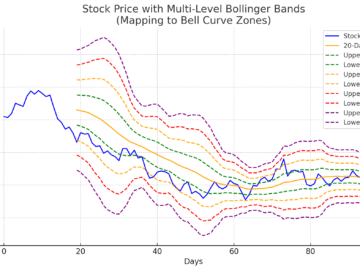
Definition and Core Concept
Bollinger Bands are a popular technical analysis tool used by traders to measure market volatility and identify potential price movements. Developed by John Bollinger in the early 1980s, these bands consist of three lines: a simple moving average (SMA) in the middle and two outer bands, which are standard deviations away from the SMA. This setup provides traders with a framework for understanding whether prices are high or low relative to recent trading activity.
Historical Context or Origin
The concept of Bollinger Bands was introduced by John Bollinger in his book, “Bollinger on Bollinger Bands.” The technique was developed from the principles of statistical analysis, particularly the use of standard deviations to measure volatility. Over the years, the tool gained popularity among stock traders and has extended its application to forex and cryptocurrency markets.
How It Works in Modern Markets
Today, Bollinger Bands are utilized by traders across various asset classes including stocks, forex, and cryptocurrencies. The bands adjust dynamically to price movements, making them a versatile tool in fluctuating markets.
Stocks
In stock trading, Bollinger Bands can help to identify overbought or oversold conditions. When prices touch the upper band, it may indicate that the stock is overbought, while touching the lower band may suggest it is oversold.
Forex
In forex markets, traders employ Bollinger Bands to gauge volatility before entering trades. A squeeze setup, where the bands narrow, can signal coming price action.
Crypto
Cryptocurrency traders often use Bollinger Bands to exploit the high volatility characteristic of these markets. The bands can help identify reversal points or potential breakouts in the erratic price movements common in crypto assets.
Common Strategies and Applications
Traders implement various strategies involving Bollinger Bands to optimize their market entries and exits.
- Squeeze Setup: This occurs when the bands tighten, indicating low volatility. Traders often anticipate a breakout, as price tends to move sharply post-squeeze.
- Breakout Trading: When the price breaks through the upper or lower band, it could signify a potential continuation or reversal of the trend.
- Reversal Trading: Prices moving towards the bands may indicate reversals. For example, a price hitting the upper band could suggest a sell signal.
Real-World Examples and Use Cases
Let’s look at practical scenarios to better understand how Bollinger Bands can be applied in trading.
Example 1: Squeeze Setup in Stocks
A trader notices that a particular stock has been trading within a narrow range for weeks. The Bollinger Bands contract significantly, signaling a potential squeeze. When the stock price finally breaks above the upper band, the trader takes a long position.
Example 2: Breakout in Forex
During an economic report release, forex pairs often display volatility. A trader utilizes Bollinger Bands to identify patterns. Upon seeing the price breakout from the upper band, the trader might enter a buy position, anticipating further upward momentum.
Advantages, Risks, and Misconceptions
Like all technical tools, Bollinger Bands have both advantages and limitations.
Advantages
- They provide a visual representation of volatility.
- Can be combined with other indicators for more robust strategies.
- Flexibility across various asset classes.
Risks
- False signals can occur, especially in volatile markets.
- Overreliance on any single indicator can lead to pitfalls.
Misconceptions
- Some traders believe Bollinger Bands are standalone indicators, ignoring the importance of market context.
- The bands are not predictive of future movements; they merely show current market conditions.
Expert Insights and Best Practices
Successful traders often share insights on maximizing the effectiveness of Bollinger Bands.
- Use Bollinger Bands in conjunction with volume indicators for confirmation.
- Pay attention to market news and events that can affect volatility.
- Adjust the moving average and standard deviation settings based on specific asset characteristics.
Key Takeaways for Traders or Investors
Understanding Bollinger Bands can enhance a trader’s toolkit and lead to more informed decision-making:
- The bands adapt to market volatility, providing context for price movements.
- Various strategies can be employed to leverage Bollinger Bands effectively.
- Always consider market conditions and combine with other indicators for best results.
Summary and Conclusion
Bollinger Bands are an invaluable technical tool that helps traders navigate the complexities of market volatility. By observing how the bands behave in various market conditions, traders can anticipate potential breakouts and reversals. Embracing Bollinger Bands as part of a broader trading strategy can yield meaningful insights and enhance trading performance.