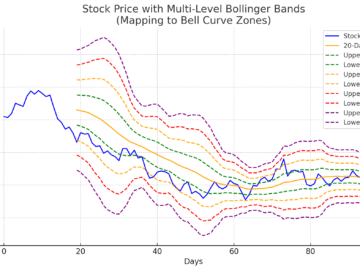
Bollinger Bands Definition and Core Concept
Bollinger Bands are a technical analysis tool used to measure market volatility and identify potential price movements. Developed by John Bollinger in the early 1980s, the indicator consists of three lines: the middle band, which is typically a simple moving average (SMA), and two outer bands that are set two standard deviations away from the SMA. This structure allows traders to visualize volatility and help identify overbought or oversold conditions in the market.
Historical Context or Origin
The concept of Bollinger Bands was introduced in the 1980s by John Bollinger, who sought to create a dynamic tool that could adapt to various market conditions. The original aim was to provide traders with a better understanding of price movements and volatility, as traditional moving averages often lacked real-time responsiveness. Bollinger Bands have since grown in popularity and have become a standard indicator in various trading platforms.
How It Works in Modern Markets
Bollinger Bands are applied across different financial markets, including stocks, forex, and cryptocurrencies. The flexibility of the Bands makes them useful in various timeframes, allowing traders to adapt their strategies based on market conditions. The bands expand and contract based on market volatility: when the market is volatile, the bands widen; when the market is stable, the bands narrow.
Stocks
In stock trading, Bollinger Bands help traders identify entry and exit points by signaling potential reversals or breakouts. Stocks trading near the upper band may indicate overbought conditions, while those close to the lower band may signal oversold conditions.
Forex
In the forex market, traders use Bollinger Bands in conjunction with other indicators, such as moving averages or relative strength index (RSI), to improve the accuracy of trades. The bands help assess price swings and potential trend reversals.
Crypto
Simplifying volatility analysis in cryptocurrency markets can be challenging due to their inherent price movements. Bollinger Bands assist traders by providing a visual representation of recent price volatility, making it easier to identify breakout opportunities.
Common Strategies and Applications
Traders employ several strategies when utilizing Bollinger Bands:
- Bollinger Band Squeeze: A squeeze occurs when the bands narrow, indicating low volatility and potential for price movement. Traders often look for breakouts from this condition.
- Breakout Trading: When the price breaks through the upper or lower band, traders may take positions, anticipating the continuation of the trend.
- Reversal on Bands: Price bouncing off the upper or lower band can indicate reversal points, signaling potential entry or exit points.
Real-World Examples and Use Cases
Traders can apply Bollinger Bands in various scenarios:
- In a rising market, if a stock consistently closes near the upper band, it may suggest that it is overbought, signaling a potential sell opportunity.
- If a stock price is consolidating in a tight range, the Bollinger Band Squeeze indicates a possible breakout, prompting traders to be ready for movement.
- In volatile markets, watching for a bounce from the lower band may signal an opportunity for long positions.
Advantages, Risks, and Misconceptions
Advantages
- Visual representation of volatility.
- Dynamic adjustment to market conditions.
- Can be combined with other indicators for improved analysis.
Risks
- False breakouts can lead to losses.
- Over-reliance on the indicator without considering fundamental factors.
Misconceptions
One common misconception is that Bollinger Bands predict future price movements. Instead, they are best used as a complement to other tools and strategies, helping traders make informed decisions rather than acting on their own.
Expert Insights and Best Practices
Experts suggest that traders should:
- Combine Bollinger Bands with other indicators, such as trend lines or volume, for better context.
- Pay attention to the squeeze phase, as it often precedes significant price movement.
- Adjust the standard deviation setting to suit different markets or trading styles.
Key Takeaways for Traders or Investors
Understanding Bollinger Bands can enhance trading strategies. They provide insight into market volatility, potential breakouts, reversals, and overbought or oversold conditions. However, traders should use them in conjunction with other tools for more accurate analysis.
Summary and Conclusion
Bollinger Bands remain a relevant and widely used technical analysis tool. Their ability to adapt to changing market conditions makes them valuable for traders in stocks, forex, and cryptocurrency markets. Properly applied, Bollinger Bands can provide insights that help traders make more informed decisions.
Further Reading & References
Six Sigma Tools and Trading: Connecting Standard Deviation, Bell Curve, Variance, and VolatilityBollinger Bands 101: Measuring Volatility Fundamentals (Intermediate)