Definition and Core Concept
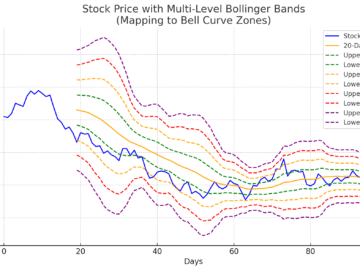
Bollinger Bands are a popular technical analysis tool developed by John Bollinger in the 1980s. They consist of three lines: a simple moving average (SMA) in the middle, the upper band, and the lower band. The bands are plotted two standard deviations above and below the SMA, which helps traders visualize market volatility. Bollinger Bands are widely used to identify potential buy and sell signals based on the price movements of a financial instrument.
Historical Context or Origin
The concept of Bollinger Bands originated from the need to measure market volatility and price dynamics. John Bollinger created this tool to assist traders in identifying periods of low and high volatility. The use of standard deviations as a way to quantify volatility stemmed from statistical principles, making Bollinger Bands a unique approach to traditional moving averages. Since their introduction, they have been integrated extensively into various trading platforms and strategies.
How It Works in Modern Markets
Application in Different Markets
Bollinger Bands can be effectively applied to various markets, including stocks, forex, and crypto. Here’s how they function in each context:
- Stocks: Traders often use Bollinger Bands to gauge volatility and assess potential breakout patterns in stock prices.
- Forex: In the forex market, traders utilize Bollinger Bands for both short-term and long-term trading strategies, adjusting the bands to accommodate different currency pairs.
- Crypto: The cryptocurrency market, known for its high volatility, is well-suited for Bollinger Bands, allowing traders to capitalize on rapid price fluctuations.
Common Strategies and Applications
Squeeze Setup
The squeeze setup occurs when the bands contract, indicating low volatility and the potential for a significant price move. Traders watch for a breakout above or below the bands to enter positions.
Breakout Trading
When the price breaks out of the upper or lower band, it signals a potential continuation of the trend. Traders often look for confirmation via volume to validate the breakout.
Reversal on Bands
Reversals may occur when prices hit the upper or lower bands, suggesting that the price may revert to the mean. This strategy involves looking for additional signals, such as candlestick patterns or other technical indicators.
Real-World Examples and Use Cases
Bollinger Bands can be observed in action through various trading scenarios. For instance, during a market downturn, the bands may widen significantly, indicating increased volatility. Conversely, during a stable market, the bands contract, signaling potential low volatility environments.
Advantages, Risks, and Misconceptions
Advantages
- Helps identify overbought and oversold conditions effectively.
- Visual representation of volatility assists in risk management.
- Can complement other technical indicators for better trading signals.
Risks
- False signals may occur, leading to potential losses.
- Over-reliance on any single indicator can obscure the bigger picture.
Misconceptions
One common misconception is that Bollinger Bands are a stand-alone trading system. They are best used in conjunction with other technical analysis tools to enhance decision-making.
Expert Insights and Best Practices
Experts recommend using Bollinger Bands in combination with other indicators such as the Relative Strength Index (RSI) or Moving Average Convergence Divergence (MACD) for a more comprehensive analysis. Adjustments to the band settings, such as changing the number of standard deviations or the moving average period, can also tailor the bands to fit individual trading strategies.
Key Takeaways for Traders or Investors
- Bollinger Bands help in assessing market volatility and potential price movements.
- Utilizing multiple indicators can enhance the effectiveness of trading strategies.
- Traders should remain aware of market conditions and adjust their strategies accordingly.
Summary and Conclusion
Bollinger Bands are a versatile tool for traders looking to understand market volatility and identify potential trading opportunities. When used appropriately, they can enhance market analysis and decision-making. Whether in stocks, forex, or crypto, Bollinger Bands serve as a valuable resource for both new and experienced traders.