Understanding Strike Prices: The Foundation of Institutional Options Overlays
Strike prices are fundamental to options valuation, portfolio risk management, and institutional capital allocation. For sophisticated investors, understanding strike prices requires more than identifying the level at which an option can be exercised. The strike determines how an options overlay interacts with an underlying equity investment, influencing potential returns, downside protection, liquidity requirements, and long-term compounding.
Canadian institutional investors, including the Canada Pension Plan Investment Board (CPP Investments), Ontario Teachers’ Pension Plan (OTPP), and Healthcare of Ontario Pension Plan (HOOPP), operate within investment frameworks emphasizing long-term capital preservation, diversification, and sustainable risk-adjusted returns.
Although these institutions differ in their mandates and implementation strategies, their investment philosophies provide a useful framework for evaluating derivative overlays. This discussion uses covered calls as an illustrative institutional strategy rather than suggesting that any particular pension fund systematically employs the specific techniques described.
For a long-term equity investor, understanding strike prices means examining how an option’s exercise level affects the economic ownership of productive corporate assets.
What Is a Strike Price?
A strike price, also called an exercise price, is the predetermined price at which the holder of an option may buy or sell an underlying security under the terms of the contract.
Call options provide the holder with the right, but not the obligation, to purchase an underlying asset at the strike price. Put options provide the corresponding right to sell.
For standardized equity options, contracts commonly represent 100 shares, although contract specifications can vary.
Consider an institutional portfolio holding 10,000 shares of a Canadian utility company trading at $100 per share.
The portfolio manager writes 100 call contracts with a strike price of $110 and receives a premium of $2 per share.
The economic characteristics are straightforward:
- Underlying equity exposure: $1,000,000.
- Call strike price: $110.
- Premium received: $20,000.
- Contract exposure: 10,000 shares.
- Premium relative to initial equity value: 2%.
- Maximum gross proceeds if all shares are assigned: $1,100,000.
If the shares remain below $110 through expiration, the calls generally expire without exercise, assuming no earlier assignment.
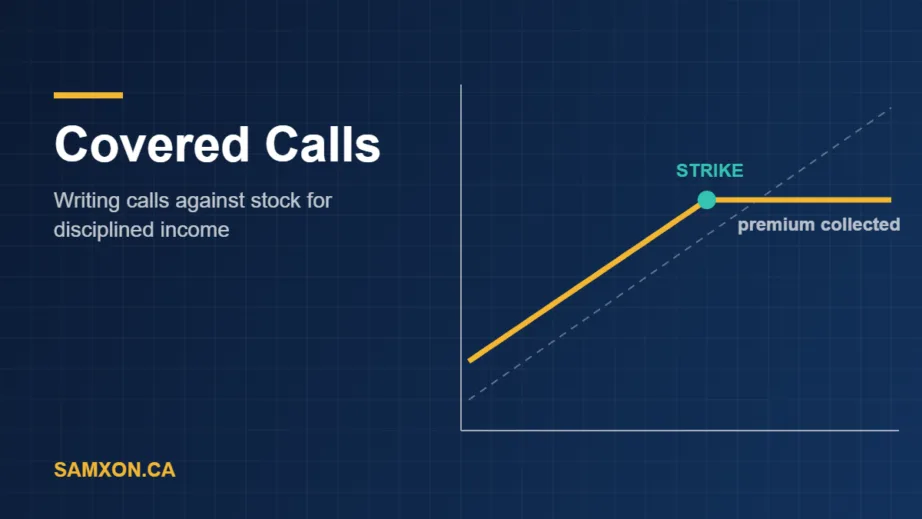
If the shares appreciate substantially above $110, the portfolio’s participation in further appreciation is limited because the written calls create an obligation to deliver shares at the contractual strike.
This illustrates why strike prices are strategic portfolio parameters rather than isolated trading inputs.
For additional background on option contracts, exercise rights, and basic terminology, see What Is Options Investing?.
Strike Prices and Corporate Intrinsic Value
Institutional investors should evaluate strike prices relative to an estimate of corporate intrinsic value rather than selecting them exclusively through technical indicators or premium maximization.
Fundamental valuation typically begins with a company’s ability to generate sustainable free cash flow.
Free cash flow to the firm can be expressed as:
FCFF = EBIT × (1 − Tax Rate) + Depreciation and Amortization − Capital Expenditures − Changes in Net Working Capital.
Projected FCFF can then be discounted using an appropriate weighted average cost of capital to estimate enterprise value.
After accounting for net debt and other claims, investors can estimate the intrinsic value attributable to common shareholders.
Suppose a regulated utility trades at $100 while a fundamental valuation produces an estimated intrinsic value of $115.
Writing a covered call at $105 may appear attractive because the option carries a relatively substantial premium. However, it potentially transfers a meaningful portion of the expected convergence toward intrinsic value to the option buyer.
A $120 strike provides greater appreciation capacity, although the premium will generally be smaller when other variables remain unchanged.
Understanding strike prices therefore involves balancing three variables: current market valuation, estimated intrinsic value, and the compensation received for surrendering potential upside.
For long-duration investors, selecting a strike below estimated intrinsic value requires an explicit justification based on portfolio constraints, valuation uncertainty, or expected risk-adjusted outcomes.
Covered Calls as an Institutional Overlay Strategy
A covered call combines ownership of an underlying security with the sale of a call option against that position.
The underlying investment remains the primary source of economic exposure. The option is a secondary instrument designed to modify the distribution of portfolio returns.
This distinction matters within pension investment frameworks.
Large pension investors generally evaluate investment decisions through asset-liability management, liquidity forecasting, diversification, and long-term expected returns.
A covered-call overlay may complement those objectives when applied selectively to liquid, publicly traded equity holdings.
The overlay can generate additional cash receipts during periods of sideways or moderately appreciating markets. However, it also reduces participation in substantial price appreciation.
Accordingly, covered calls should not automatically be described as return-enhancing instruments.
Their contribution depends on realized market behavior, option pricing, transaction expenses, taxation, and the opportunity cost of surrendered upside.
A disciplined implementation process may involve:
- Identifying fundamentally attractive companies with sustainable cash flows.
- Estimating intrinsic value and reasonable valuation ranges.
- Evaluating implied volatility relative to historical and expected realized volatility.
- Selecting strike prices consistent with portfolio appreciation objectives.
- Managing expiration dates, assignment exposure, and liquidity requirements.
- Measuring overlay performance against an equivalent unhedged equity portfolio.
The practical implementation of this structure is explored in Writing Covered Calls: How to Turn Your Stocks Into Steady Income.
Understanding Strike Prices Through Moneyness
Option moneyness describes the relationship between the underlying security’s market price and the contractual strike.
In-the-Money Calls
A call is in the money when the underlying share price exceeds the strike price.
For example, a call with a $95 strike is in the money when the stock trades at $100.
Such options contain intrinsic value and generally provide greater initial premium receipts than otherwise comparable out-of-the-money calls.
However, covered-call writers face a greater likelihood of assignment, particularly near expiration.
At-the-Money Calls
An at-the-money call has a strike approximately equal to the current share price.
These contracts often contain substantial time value because the outcome at expiration remains highly sensitive to relatively small price movements.
At-the-money covered calls provide relatively high premium receipts but substantially restrict potential share-price appreciation.
Out-of-the-Money Calls
An out-of-the-money call has a strike above the current share price.
These contracts preserve some appreciation potential before the option begins restricting further gains.
For institutional portfolios prioritizing long-term ownership, moderately out-of-the-money calls may offer a more appropriate balance between premium collection and retained upside.
Understanding strike prices through moneyness helps explain why the highest available premium is not necessarily the most attractive institutional outcome.
Cost-Basis Reduction and the Synthetic Dividend Concept
Covered-call premiums are sometimes described as synthetic dividends because they generate cash receipts while the investor maintains an underlying equity position.
However, this terminology requires careful interpretation.
A corporate dividend represents a distribution authorized by the company and funded through its financial resources.
An option premium represents compensation received from another market participant in exchange for assuming a contractual obligation.
These cash flows have fundamentally different economic origins.
Consider an investor purchasing 1,000 shares at $100 each.
The initial investment is $100,000.
The investor subsequently receives $2,000 from writing covered calls.
For performance analysis, the premium can be viewed as reducing the position’s economic break-even level from $100 to $98 per share, before expenses and taxes.
Economic break-even = Initial purchase price − Net option premium received per share.
This adjustment does not necessarily represent the position’s legal or tax-adjusted cost basis. Canadian tax treatment depends on the circumstances of the option transaction, including whether contracts expire, are closed, or are exercised.
The premium also does not permanently guarantee a lower effective acquisition cost.
Subsequent option losses, repurchase expenses, or unfavorable assignment outcomes can offset earlier receipts.
Nevertheless, periodic premium collection can provide a modest first layer of downside absorption.
If a stock declines from $100 to $90 after a $2 premium has been collected, the combined position loses approximately $8 per share rather than $10, excluding dividends and transaction costs.
That difference improves the realized outcome but does not establish comprehensive downside protection.
Implied Volatility and Institutional Risk Pricing
Implied volatility measures the volatility assumption embedded in market option prices.
It is inferred from observed option premiums using an option-pricing framework.
Higher implied volatility generally increases the theoretical value of options because larger potential price movements increase the value of contractual optionality.
For covered-call writers, elevated implied volatility can create opportunities to receive larger premiums for comparable strike prices and maturities.
However, higher premiums are not necessarily evidence of superior investment opportunities.
They frequently reflect greater uncertainty about the underlying company’s future value.
During periods of market stress, investors may demand substantial compensation for bearing equity risk, while option markets price a wider distribution of possible outcomes.
An institutional manager may respond by selectively supplying volatility through covered-call writing.
This approach can partially offset subsequent equity declines through premium receipts.
Importantly, selling covered calls is not equivalent to purchasing downside insurance.
The premium provides only a limited cushion, and the underlying shares retain nearly all their downside exposure beyond that amount.
Institutional risk committees should therefore distinguish premium collection from genuine downside hedging.
Implied Versus Realized Volatility
A useful analytical comparison is the relationship between implied volatility and subsequent realized volatility.
When implied volatility exceeds the volatility ultimately experienced by the stock, option sellers may receive favorable compensation for the risks assumed.
This relationship is often described through the volatility risk premium.
However, realized volatility is unknown when the contract is initiated.
Moreover, a stock can experience a large upward movement even when its overall realized volatility remains consistent with expectations.
For a covered-call portfolio, such appreciation can create substantial opportunity costs.
Therefore, understanding strike prices requires evaluating both volatility compensation and the potential distribution of future share prices.
Strike Selection Using Delta and Expiration
Institutional managers frequently use option Greeks to quantify portfolio sensitivities.
Delta measures the approximate change in an option’s value for a one-unit change in the underlying security’s price, holding other relevant factors constant.
For a call option, delta generally ranges between zero and one.
A call with a delta of 0.25 is often interpreted as having a relatively limited likelihood of expiring in the money.
However, delta is only an approximation to an expiration probability under particular modeling assumptions. It is not a guaranteed statistical forecast.
Lower-delta covered calls generally preserve greater upside potential but generate smaller premiums.
Higher-delta calls typically produce larger premiums while increasing assignment exposure.
Expiration selection also influences the economic outcome.
Shorter-dated options generally experience faster time-value decay as expiration approaches, although they require more frequent implementation decisions.
Longer-dated options provide extended premium exposure but can restrict portfolio flexibility over a greater period.
Institutional strike selection must therefore consider delta, maturity, liquidity, transaction costs, expected dividends, and fundamental valuation simultaneously.
The Maple 8 Perspective: Long-Duration Capital Allocation
Canada’s major pension organizations, often collectively described as the Maple 8, are recognized for allocating substantial capital across public equities, private equity, infrastructure, real estate, and fixed-income investments.
Institutions such as CPP Investments and Ontario Teachers’ emphasize long-term investment horizons and diversified exposure to productive assets.
Infrastructure and regulated utility investments can be particularly relevant because their cash flows may extend across multiple decades.
These assets often involve significant initial investment, predictable contractual or regulated revenue frameworks, and continuing capital expenditure requirements.
For a pension portfolio, the challenge is matching long-duration investment opportunities with projected benefit payments and liquidity needs.
Derivative overlays can potentially modify the timing and distribution of portfolio cash flows without requiring the immediate liquidation of underlying investments.
However, an important distinction is necessary.
Standard listed covered calls require suitable deliverable securities. They cannot simply be written against an illiquid, directly owned infrastructure asset.
Exposure to private infrastructure would require a separately structured derivative arrangement, potentially involving public-market proxies or customized instruments that introduce basis, counterparty, and liquidity risks.
Consequently, understanding strike prices within the Maple 8 framework is most directly applicable to liquid public-equity portfolios and appropriately collateralized synthetic exposures.
The broader institutional lesson is that derivatives should support an established investment mandate rather than substitute for fundamental asset quality.
Dividend Sustainability: Net Income Versus Free Cash Flow
For dividend-oriented institutional investors, understanding the underlying company’s financial capacity is essential before selecting strike prices.
A company may report attractive earnings while generating insufficient cash to support its dividend and reinvestment commitments.
Net income incorporates accounting assumptions, accruals, and noncash expenses.
Free cash flow reflects operating cash generation after capital expenditure.
Consider a utility reporting the following hypothetical annual results:
- Net income: $800 million.
- Operating cash flow: $1.4 billion.
- Capital expenditures: $1.1 billion.
- Free cash flow: $300 million.
- Common dividends: $500 million.
The earnings payout ratio is 62.5%, calculated as $500 million divided by $800 million.
At first glance, this appears manageable.
However, the free-cash-flow payout ratio is approximately 167%.
The company’s dividends exceed free cash flow by $200 million.
This does not automatically mean the dividend is unsustainable.
Regulated utilities frequently undertake major capital programs whose economic benefits extend well beyond the current accounting period.
Growth capital expenditure may be supported by regulated rate-base expansion, future tariff adjustments, and access to long-term financing.
Nevertheless, investors must determine whether the company’s financing model remains sustainable across interest-rate cycles.
Maintenance Versus Growth Capital Expenditure
Separating maintenance capital expenditure from growth investment is especially important.
Maintenance expenditure supports the existing asset base.
Growth expenditure expands productive capacity or increases future earnings potential.
Although both require cash, they have different implications for long-term corporate value.
A utility with temporarily negative free cash flow may still create shareholder value if growth projects earn returns above the company’s weighted average cost of capital.
Conversely, a company repeatedly financing dividends through incremental borrowing may weaken its capital structure.
Relevant indicators include interest coverage, net debt relative to EBITDA, refinancing requirements, credit ratings, and the spread between return on invested capital and cost of capital.
Covered-call premiums cannot repair a structurally unsustainable corporate payout policy.
Understanding strike prices is therefore secondary to establishing that the underlying investment possesses durable financial characteristics.
Strike Prices, Dividends, and Early Assignment
Dividend-paying equities introduce an additional consideration for covered-call overlays.
Many North American single-stock options are American-style contracts, meaning holders may exercise them before expiration.
Early exercise becomes particularly relevant when an in-the-money call approaches the underlying stock’s ex-dividend date.
If the remaining extrinsic value of the option is smaller than the economic benefit of exercising to capture the dividend, early assignment risk can increase.
For long-term dividend investors, this matters because assignment may result in shares being delivered before the investor receives the anticipated dividend.
The portfolio manager must evaluate the interaction between strike price, intrinsic value, remaining time value, and the dividend schedule.
Institutional oversight should also incorporate settlement requirements and the possibility that shares may be removed from the portfolio earlier than expected.
A strategy designed to complement dividend ownership can become counterproductive if assignment repeatedly disrupts the intended equity exposure.
Long-Term Compounding and Dividend Reinvestment
Institutional investment performance is ultimately determined by the compounding of total returns over extended periods.
The standard compound-growth relationship is:
Future Value = Initial Capital × (1 + Annual Return)^Years.
Consider a hypothetical $1 million portfolio invested for 30 years.
At a 6% annualized total return, the portfolio grows to approximately $5.74 million.
At 7%, the terminal value increases to approximately $7.61 million.
That one-percentage-point annual difference produces roughly $1.87 million in additional terminal wealth.
These calculations demonstrate why small changes in long-term return assumptions can have substantial consequences for pension funding and private wealth preservation.
Dividend reinvestment plans, commonly called DRIPs, can support compounding by using cash distributions to acquire additional shares.
Additional shares may subsequently produce larger dividend receipts, creating a reinforcing accumulation process.
However, dividend reinvestment does not independently create economic value.
Its contribution depends on the underlying company’s operating performance, valuation, dividend sustainability, and the investor’s alternative uses of capital.
Covered-call overlays complicate this equation.
Premium receipts can be reinvested, increasing the amount of capital exposed to productive assets.
But the investor may surrender substantial appreciation during strong equity markets.
Understanding strike prices is essential because an aggressively positioned covered-call program can reduce the long-term growth rate even while increasing current cash receipts.
Evaluating the Covered-Call Total Return Profile
The appropriate measure of overlay performance is total return, not premium yield in isolation.
Consider a stock purchased at $100.
An investor writes a call with a $110 strike and receives a $2 premium.
Assume the option expires after one year and ignore dividends, taxes, and transaction costs.
Scenario One: The Stock Declines to $90
The unhedged equity position loses $10 per share.
The covered-call position receives $2 in premium and experiences an $8 net loss.
The overlay modestly improves the outcome without preventing the decline.
Scenario Two: The Stock Finishes at $105
The unhedged position gains $5.
The covered-call position gains $5 in share appreciation plus $2 in premium.
The overlay outperforms by $2 per share.
Scenario Three: The Stock Advances to $125
The unhedged investor earns $25 per share.
The covered-call investor captures $10 of appreciation plus the $2 premium.
Total profit is limited to $12 per share.
The overlay underperforms by $13 per share.
These scenarios illustrate that premium collection changes the distribution of outcomes rather than creating an independent source of guaranteed return.
The terminal payoff of a covered call, excluding dividends and costs, can be expressed as:
Profit = Minimum of Terminal Stock Price and Strike Price − Initial Stock Price + Premium Received.
Understanding strike prices allows portfolio managers to quantify precisely how much appreciation capacity is exchanged for upfront option compensation.
Risk Management and Capital Preservation
Capital preservation in institutional portfolios involves more than minimizing short-term market fluctuations.
It requires maintaining sufficient liquidity, managing leverage, protecting long-term purchasing power, and avoiding permanent impairment of invested capital.
Covered-call overlays can support selected risk-management objectives, but they introduce their own limitations.
Upside participation becomes restricted above the strike price. Liquidity demands can increase when managers attempt to repurchase appreciated calls. Tax considerations may affect implementation efficiency. Repeated assignment can disrupt strategic asset allocation.
Furthermore, option premiums are often highest when market uncertainty is elevated.
Those conditions may coincide with deteriorating earnings expectations, widening credit spreads, or significant changes in corporate discount rates.
An institution should not interpret high implied volatility as sufficient justification for selling options.
The underlying company’s balance sheet, cash-flow resilience, and valuation must remain central.
Where formal downside protection is required, protective puts or other explicitly hedged structures may be more suitable, although their costs can materially reduce expected returns.
The relationship between exercise prices and downside contracts is examined in Understanding Put Options.
Integrating Macro Signals With Bottom-Up Valuation
Institutional strike selection benefits from combining company-specific analysis with broader financial conditions.
Interest rates influence corporate financing costs, equity discount rates, and the relative attractiveness of dividend-paying securities.
Inflation affects operating expenses, replacement capital costs, and the real value of future distributions.
Credit spreads provide information about financing conditions and perceived balance-sheet risk.
These variables can influence both fundamental equity values and the implied volatility embedded in option markets.
For example, rising long-term interest rates may increase a utility company’s weighted average cost of capital while simultaneously pressuring the valuation of its existing cash flows.
In that environment, elevated call premiums should be evaluated against the possibility that intrinsic value itself has declined.
Conversely, improving financing conditions may support higher equity valuations and greater appreciation potential.
Writing calls too close to the prevailing market price could then sacrifice a meaningful portion of the resulting recovery.
Technical indicators may assist with implementation timing, but they should remain subordinate to fundamental valuation and risk controls.
For readers examining momentum as a supplementary market signal, the MACD: Momentum, Crossovers, and the Percentage Price Oscillator guidebook is a recommended resource for understanding momentum measurement alongside a fundamentals-based investment process.
Building an Institutional Strike Selection Framework
A disciplined framework should begin by establishing whether the underlying equity deserves a place in the long-term portfolio independently of any option premium.
The next step is determining the minimum acceptable sale price based on intrinsic value, expected dividend growth, and the investor’s required return.
Understanding strike prices at this stage involves treating the exercise level as a potential future disposition price.
Managers should then compare available premiums across strike prices and maturities, adjusting for implied volatility, liquidity, and transaction costs.
Scenario analysis should evaluate severe declines, moderate appreciation, and substantial upside movements.
Performance measurement should compare the overlay with a clearly defined unhedged benchmark over complete market cycles.
Finally, governance controls should establish exposure limits, assignment procedures, collateral requirements where applicable, and circumstances under which the overlay should be suspended.
For pension-oriented capital allocation, the primary objective is not maximizing premium receipts. It is improving the portfolio’s overall risk-adjusted return characteristics without undermining long-term funding requirements.
Conclusion: Strike Prices as Strategic Capital Allocation Decisions
Understanding strike prices is central to the responsible use of equity options within long-term institutional portfolios.
The strike determines the relationship between current compensation and future appreciation rights. It also influences assignment exposure, volatility sensitivity, liquidity management, and the economic effectiveness of a covered-call overlay.
For investors applying the long-duration principles associated with major Canadian pension institutions, option premiums should be evaluated as compensation for transferring a portion of future equity upside.
They are not substitutes for sustainable corporate dividends, strong free cash flow, prudent leverage, or disciplined intrinsic-value analysis.
The most defensible overlay framework begins with high-quality underlying assets, establishes valuation-based strike thresholds, and measures success through multi-cycle total returns.
Ultimately, understanding strike prices allows institutional and sophisticated private investors to connect derivative pricing with the central objective of fundamental investing: preserving capital while compounding ownership in financially productive businesses over time.
For reference, the technical definitions of strike prices and exercise levels, the contractual structure of financial options, and the mechanics of put options provide additional context for evaluating derivative overlays and their associated risks.
Explore more articles in our Covered Calls section.
Related reading: Understanding Strike Prices