In technical analysis, an oscillator is one of the most widely used tools for identifying overbought and oversold conditions, spotting momentum shifts, and predicting potential market reversals.
Whether you trade stocks, forex, crypto, or commodities, understanding oscillators can sharpen your market timing and improve decision-making.
1. What Is an Oscillator?
An oscillator is a mathematical indicator that fluctuates within a bounded range, often between two fixed values, to measure market momentum. Think of it like a pendulum that swings back and forth in response to price changes — not showing raw prices, but a scaled value that makes it easier to spot when markets may be “too high” or “too low.”
Most oscillators are normalized, meaning they produce readings within a consistent range (e.g., 0–100, -100 to +100, or -1 to +1). This makes it easier to compare different markets or timeframes.
2. Why Traders Use Oscillators
Oscillators serve several important purposes:
- Identify Overbought Conditions
When the oscillator is near the top of its range, the market may be stretched upward and due for a pullback. - Identify Oversold Conditions
When the oscillator is near the bottom of its range, the market may be stretched downward and due for a rebound. - Spot Momentum Shifts
Oscillators often turn before price does, making them useful for early reversal warnings. - Filter Market Noise
By smoothing and scaling price data, oscillators help traders focus on the speed and strength of price moves rather than raw volatility.
3. Common Types of Oscillators
Here are some of the most popular oscillators used by traders worldwide:
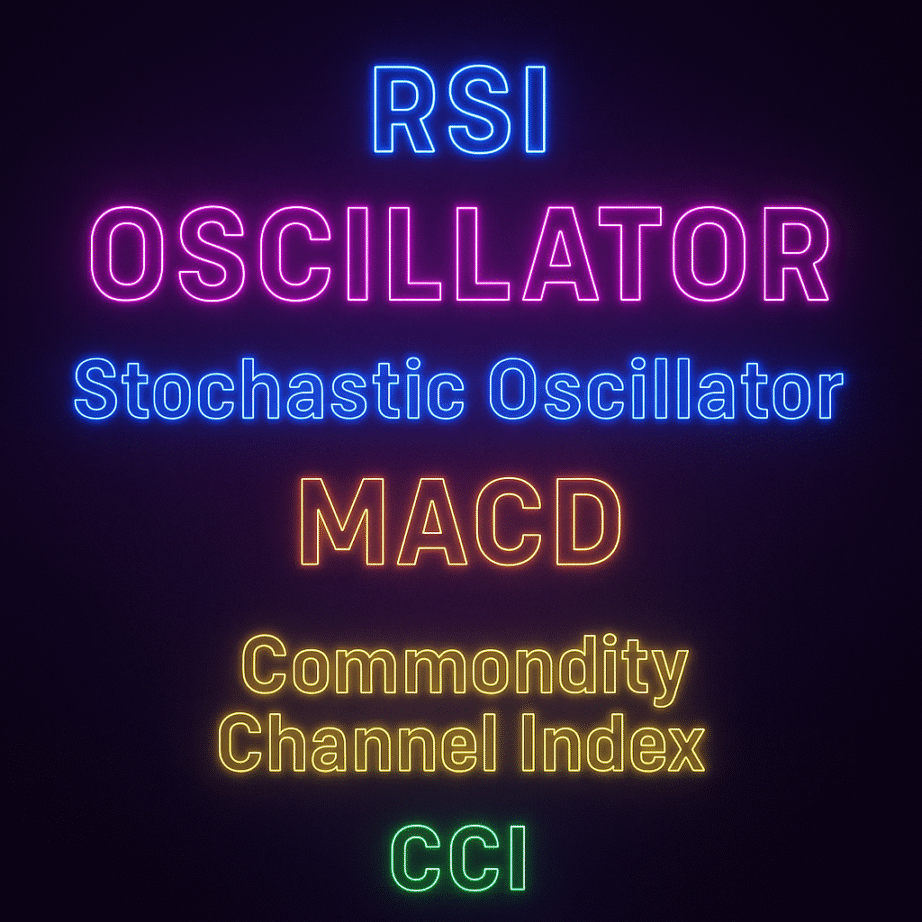
- Relative Strength Index (RSI) – Ranges from 0 to 100; overbought typically above 70, oversold below 30.
- Stochastic Oscillator – Compares the closing price to its range over a set period; also ranges 0–100.
- MACD (Moving Average Convergence Divergence) – Measures the difference between moving averages; plotted with a signal line for crossovers.
- PPO (Percentage Price Oscillator) – Similar to MACD but expressed in percentage terms.
- CCI (Commodity Channel Index) – Measures how far price deviates from its statistical average; typically ranges from +100 to -100.
4. How Oscillators Work
- Input Data – Uses price data (close, high/low, or moving averages).
- Calculation – Applies a formula, often involving moving averages or rate-of-change comparisons.
- Scaling – Normalizes the output into a fixed range.
- Interpretation – Traders look for extremes, divergences between price and oscillator, and moving average crossovers.
5. Tips for Trading With Oscillators
- Combine With Trend Analysis – In strong trends, oscillators can stay overbought or oversold for extended periods. Pair them with trend indicators like moving averages or ADX for better accuracy.
- Watch for Divergences – If price makes a new high but the oscillator doesn’t, momentum may be weakening.
- Use in Range-Bound Markets – Oscillators shine when price moves sideways, helping to catch swings from support to resistance.
Final Thoughts
Oscillators are powerful tools for identifying market extremes, timing entries and exits, and spotting early signs of momentum shifts.
However, like all technical indicators, they work best when combined with other forms of analysis — such as chart patterns, volume, and market structure.
Whether you’re a day trader, swing trader, or long-term investor, mastering oscillators can give you a significant edge in navigating the markets.
💡 Pro Tip: In a future post, we’ll break down how to use RSI, Stochastics, and PPO together for high-probability trading setups.
Originally posted 2025-08-13 01:54:17.