Measuring Volatility: Definition and Core Concept
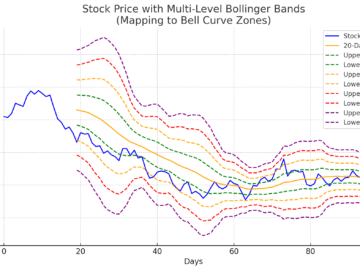
Bollinger Bands are a popular technical analysis tool used to measure market volatility and identify potential price levels. Created by John Bollinger in the early 1980s, this indicator consists of a middle band (the simple moving average) and two outer bands, which are standard deviations away from the middle band. The distance between the bands varies based on market volatility; wider bands indicate higher volatility, while narrower bands suggest lower volatility.
Historical Context or Origin
The Bollinger Bands indicator was introduced by John Bollinger in the 1980s. Bollinger, a trader and technical analyst, aimed to create a tool that could adapt to changing market conditions and accurately reflect volatility. Since its inception, Bollinger Bands have become a staple among traders in various markets, including stocks, forex, and crypto.
How Measuring Volatility Works in Modern Markets
Bollinger Bands can be applied across different asset classes, such as stocks, forex, and cryptocurrencies. The indicator provides insight into market conditions by displaying the price’s relative position within the bands. When prices move toward the upper band, it may indicate overbought conditions, while movement toward the lower band can signify oversold conditions.
Application in Different Markets
- Stocks: Traders often use Bollinger Bands to identify breakout opportunities and reversals in stock prices.
- Forex: In forex markets, the bands can help determine potential price trends and entry points for trades.
- cryptocurrency: Given the inherent volatility in crypto markets, Bollinger Bands provide valuable insights for traders testing various strategies.
Common Strategies and Applications
There are several strategies that traders commonly employ when using Bollinger Bands. These include breakout trading, mean reversion, and using the bands as dynamic support and resistance levels.
Breakout Trading Strategy
A breakout occurs when the price moves outside the Bollinger Bands. Traders may take this as a signal that a strong price movement is brewing. For instance, if the price breaks above the upper band, it can indicate a potential uptrend, while a break below the lower band may suggest a downtrend.
Mean Reversion Strategy
Mean reversion leverages the concept that prices will revert to their mean or average price over time. When the price reaches the outer bands, traders may consider entering trades that anticipate a return to the middle band.
Dynamic Support and Resistance
Bollinger Bands can also act as dynamic support and resistance levels. Prices may bounce off the bands, providing potential entry and exit points for traders.
Real-World Examples and Use Cases for Measuring Volatility
To understand how Bollinger Bands function in real market conditions, consider these examples:
- Example in Stocks: A stock trading at $100 may reach the upper band during a bullish trend, suggesting short-term overbought levels. A trader might consider selling at this point.
- Example in Forex: If a currency pair consistently bounces off the lower band over several days, it may indicate a buy signal as the price is deemed oversold.
- Example in Crypto: A cryptocurrency experiencing a rapid price increase may break the upper band, signaling the potential for a continuation or pullback.
Advantages, Risks, and Misconceptions
Advantages
- Versatile across multiple markets and asset classes.
- Helps identify volatility trends and potential breakouts.
- Offers dynamic support and resistance levels.
Risks
- False signals can lead to losses, particularly during choppy or sideways markets.
- Over-reliance on the indicator without considering other signals can be risky.
Common Misconceptions
Some traders mistakenly believe that the bands themselves predict price direction. Instead, Bollinger Bands should be used in conjunction with other indicators and analysis methods to improve overall trading effectiveness.
Expert Insights and Best Practices
To maximize the effectiveness of Bollinger Bands, consider the following expert insights:
- Combine Bollinger Bands with other indicators like Relative Strength Index (RSI) to confirm signals.
- Adjust the standard deviation settings according to the asset’s volatility to optimize the bands.
- Use Bollinger Bands in conjunction with a well-defined risk management strategy to mitigate losses.
Key Takeaways for Traders or Investors
Understanding Bollinger Bands can significantly enhance trading strategies:
- Bollinger Bands serve as a powerful tool for measuring volatility and identifying trading opportunities.
- Utilizing multiple analysis methods can improve the reliability of trading signals.
- Always incorporate risk management practices alongside technical analysis.
Summary and Conclusion
Measuring Volatility with Bollinger Bands are a foundational tool for traders and investors seeking to analyze market volatility and identify potential price movements. Their adaptability across various asset classes makes them a valuable part of any trader’s toolkit. By understanding the core concepts and applying effective strategies, traders can enhance their decision-making process and optimize their trading performance.
Further Reading & References
Volatility, Mean Reversion, Dark Pools
Bollinger Bands – Investopedia, CFA Institute Publications, CoinDesk